 Stolen Art Dealer
Stolen · 22 October 2026
Murillo's Soult Immaculate: from Seville to Paris and back
A French marshal removed Murillo's Immaculate Conception from a Seville church. The Louvre bought it in 1852, and Spain regained it by exchange in 1941.
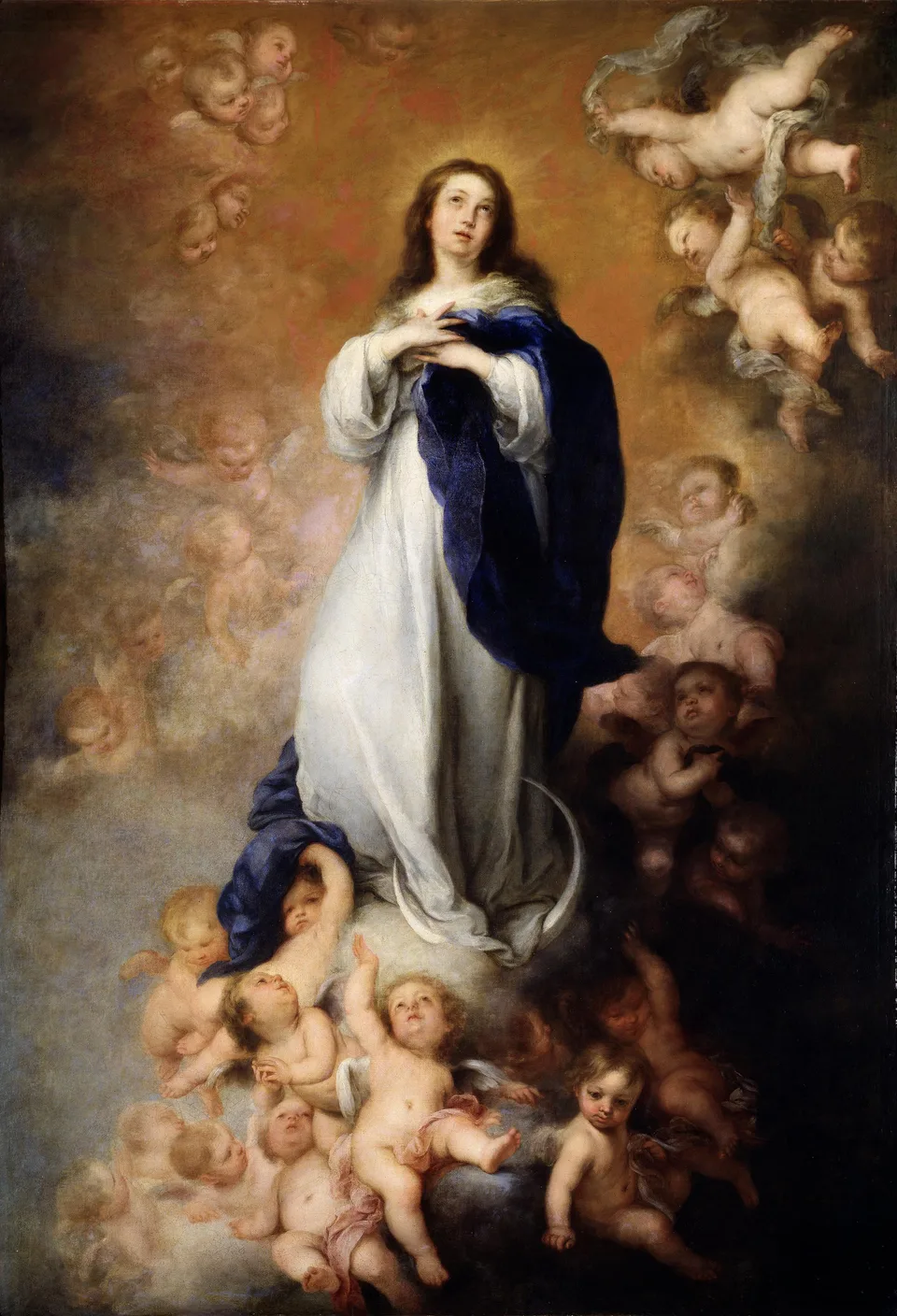
Seville, 1810. The French army of Andalusia, led by a marshal, was based in the city. The Museo del Prado, Spain’s national museum, says he stored about a thousand works from religious buildings in the Alcázar, the old royal palace. He kept the best for himself and sent them to Paris. The Prado’s record for this painting lists the Alcázar in 1810.
The canvas is Murillo’s Immaculate Conception, 274 by 190 centimetres, in oil. A Seville canon, Justino de Neve, a friend of the painter, had it made for the church of the Hospital de los Venerables Sacerdotes, a home for elderly priests. It hung there from 1686. The Prado gives two dates for it: 1660-1665 on its collection page, and about 1678 on its restoration page.
No source consulted for this entry describes how the painting left Seville, or on which day. The Prado records that it entered the marshal’s collection in 1813. Its encyclopaedia says he robbed it, and asks that the work be called “of Los Venerables”, not “of Soult”. The marshal died in 1851. No source records a charge or a trial.
In Paris the painting was relined, and heat scorched it. Old varnish was removed badly, and almost the whole surface was later repainted, the Prado says. The Revue des beaux-arts de France and All the Year Round report that the marshal sold it to the French king in 1835 for half a million francs. The contract was cancelled about a month later.
After his death the collection was sold in Paris in May 1852. A University of Seville thesis counts 157 paintings. The Louvre bought this one for the French state. All the Year Round names the day as 19 May and says an English nobleman and a Russian prince were rivals. A later essay gives 29 May.
The Prado encyclopaedia gives the price as 615,300 francs, the highest paid for a painting up to then. Other sources, among them All the Year Round, the Seville thesis and a Seville history site, give 586,000 francs. No source says whether either figure includes costs. The two differ by exactly 5 per cent. The Spectator called the price “simply preposterous”. The sources consulted give no figure in US dollars.
The painting hung in the Louvre until 1941. In late 1940, the Revue reports, Spain asked France for an exchange of works. The Murillo was the first item. The accord was made between the Pétain government and Franco’s Spain. France gave the Murillo, the Lady of Elche, Iberian sculptures, part of the Guarrazar treasure and the Simancas papers. Spain sent a portrait of Mariana of Austria then attributed to Velázquez, a Greco portrait, a Goya tapestry and French drawings. The author of the Instituto Cervantes essay calls the deal clearly advantageous to Spain. The Prado’s record says the painting was delivered on 27 June 1941. It has belonged to the Prado since then, and hangs in room 016.
Sources
- Museo del Prado: collection page for The Immaculate Conception of Los Venerables
- Museo del Prado: report on the restoration of the Soult Immaculate
- Museo del Prado encyclopaedia: entry on Soult, Nicolas Jean de Dieu, Duke of Dalmatia
- Revue des beaux-arts de France: report on the Murillo and the 1940-41 exchange (1942-43)
- All the Year Round: report on the Soult sale of 1852 (volume X)
- Great Pictures: essay on the Immaculate Conception sale of 1852
- University of Seville thesis on the Soult sale of 1852
- Sevilla Mágica y Eterna: report on the Inmaculada de los Venerables (2018)
- The Spectator: report on the Soult sale (12 June 1852)
- Instituto Cervantes: Juan Carlos Ruiz Souza, essay on the exchange of 1941 (9 January 2001)