 Stolen Art Dealer
Stolen · 22 October 2026
The Quadriga: taken to Paris, wrecked, then rebuilt
Napoleon had the Brandenburg Gate's copper chariot sent to Paris in 1806. It came home in 1814, was wrecked in 1945, scrapped in 1950 and replaced by a replica in 1958.
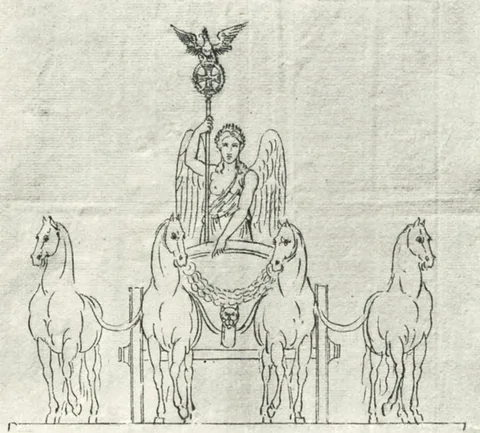
In December 1806 a coppersmith named Emanuel Jury and his crew climbed the Brandenburg Gate in Berlin and took apart the Quadriga on its roof. This was a chariot drawn by four horses, driven by the goddess Victoria. The Stiftung Stadtmuseum Berlin says Jury organised the taking down and cutting up until mid-December and was paid 1,500 thaler. The pieces left Berlin by barge on 21 December, according to Deutschlandfunk.
The Quadriga was hammered in copper. Johann Gottfried Schadow, a Berlin sculptor, designed it. Potsdam craftsmen made it between 1789 and 1793, and it stood on the Gate by mid-1793. Napoleon, the French emperor, entered Berlin on 27 October 1806, after his victories at Jena and Auerstedt. He ordered the group sent to Paris. Berlin artists signed a petition, and it did not stop him. The Stadtmuseum names Dominique-Vivant Denon, Napoleon’s art agent, in Berlin at the time and cites a letter from him dated 25 November 1806. The Prussian State Palaces and Gardens Foundation (SPSG) says it was taken as a spoil of war, for a French triumphal arch.
It reached Paris in mid-May 1807. The sculptor Charles Stanislas Canler assessed and restored it, and a site was sought. The group never went up. In late March 1814 the Allied armies entered Paris, and Prussian troops found it still in crates. The SPSG credits Field Marshal Blücher with sending it home. It travelled by land until 9 June. About fifty smiths, carpenters and labourers repaired it at the Grunewald Hunting Lodge until 18 July. It was back on the Gate on 7 August, when King Frederick William III rode in with his troops. Das Parlament reports that Berliners called it the Retourkutsche, a pun on “return coach”.
The king had the architect Karl Friedrich Schinkel design an Iron Cross for Victoria’s staff. It was set in an oak-leaf wreath, with a Prussian eagle above, and Victoria became a goddess of victory. What the staff carried before 1814 is disputed. The SPSG describes an unadorned oak-leaf wreath, with the eagle added in 1814. Helmut Caspar, in a Berlin history magazine, describes a helmet and breastplate that Schadow replaced with a wreath and eagle.
The second loss came with the Second World War. In 1942 plaster moulds were made to protect the design. In 1945 the group was heavily damaged in the last battles, and only wrecked copper and iron remained. The cause is attributed, not settled. The Stadtmuseum says deliberate fire is suspected. Der Spiegel says Soviet artillery shot at it. The remains were taken down in 1950 and scrapped, except one horse head, according to dpa. In a 1956 letter quoted by Spiegel, West Berlin’s mayor accused East Berlin officials of toppling them. That is one side’s account. The head entered the Märkisches Museum in October 1952.
A new group was hammered in copper, not cast. The Noack foundry made it in 1957 and 1958 from models taken from the 1942 moulds, and dpa reports about seventy people worked for a year. It was set on the Gate in 1958. On the night of 2 to 3 August 1958 East Berlin authorities removed the Prussian eagle and Iron Cross, and West Berlin papers first suspected theft. The emblems returned in 1991, after a restoration.
The Staatliche Museen zu Berlin says the Gate’s Quadriga is not the original. Its plaster models are closer to Schadow’s work. dpa reported in September 2026 that the surviving horse head is on show at the Märkisches Museum. A museum page has not confirmed this.
Sources
- Stiftung Stadtmuseum Berlin: Pferdekopf der Quadriga
- SPSG: Grunewald Hunting Lodge, 1814
- Deutschlandfunk: report on the Quadriga's removal from Berlin
- Deutschlandfunk: report on 225 years of the Brandenburg Gate
- Berlin history magazine, Helmut Caspar: report on the Brandenburg Gate
- Tagesspiegel (dpa): report on the Quadriga's disappearance and replica (21 Sep 2026)
- Der Spiegel: report on the Quadriga after 1945
- Der Spiegel (1991): report on the Quadriga and the Prussian emblems
- Staatliche Museen zu Berlin: report on the Quadriga plaster moulds and replica (2020)
- Staatliche Museen zu Berlin: report on the plaster model of the Quadriga (2023)
- Deutscher Bundestag: report on the reconstruction of the Quadriga (2021)
- Berliner Zeitung: report on the making of the Quadriga for the third time
- taz: report on the Quadriga, 1990
- taz: report on the Quadriga, 1991
- Das Parlament: report on the secrets of the Quadriga (2023)