 Stolen Art Dealer
Stolen · 22 October 2026
The Corot taken from the Louvre in 1998
A small Corot landscape vanished from a crowded gallery on a free Sunday in May 1998. Nobody has been charged, and it has not been found.
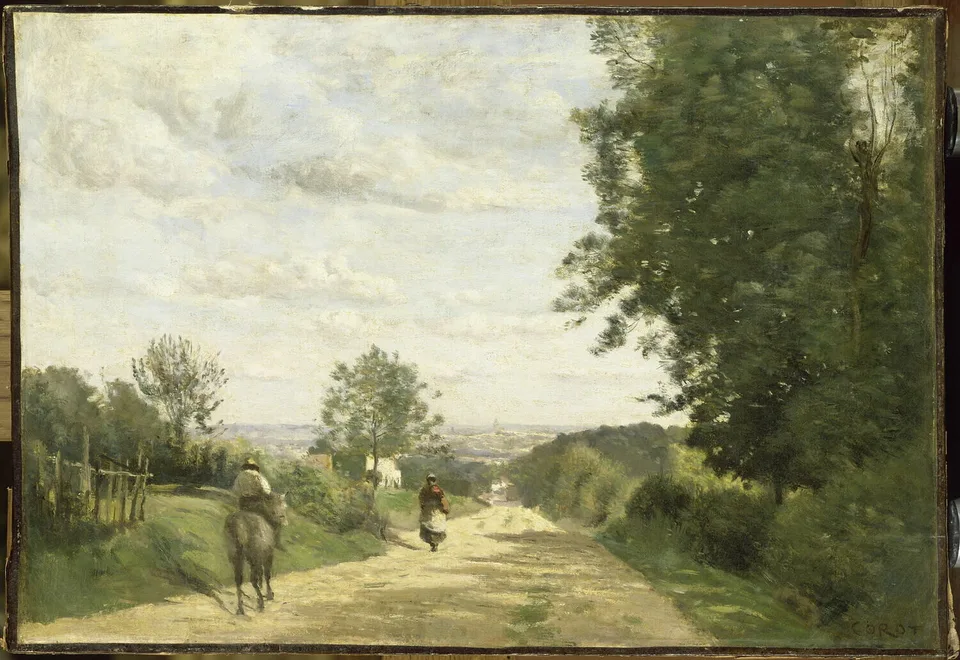
Sunday 3 May 1998 was the first Sunday of the month, so entry to the Louvre in Paris was free and the galleries were full. Early in the afternoon, someone took a small landscape by Camille Corot off the wall of room 67, on the second floor of the Sully wing. The frame stayed on the wall. Le Parisien reported that a guard raised the alarm between 13:00 and 13:30. A visitor quoted the next day said the wall was already bare at 13:15 and the alarm came about half an hour later. A police summary in the same newspaper, in 2015, gives 13:45. The sources differ on the time. They agree that the alarm was late.
The painting is Le chemin de Sèvres, oil on canvas, 34 by 49 centimetres, signed “Corot” at lower right, inventory number RF 1352. Corot was a French landscape painter who died in 1875. The Louvre dates the picture to 1850 to 1875, and the Ministry of Culture’s Joconde database says about 1855. It came to the museum in 1902 by bequest from the collector Georges Thomy Thiery. The Louvre record states that it was stolen on 3 May 1998.
The police closed the exits at about 14:00 and searched visitors and staff. Le Parisien said about 20,000 people were searched. The BBC said hundreds. The Brigade de répression du banditisme, a Paris police unit for organised crime, led the first inquiry. actu.fr reports that the Office central de lutte contre le trafic des biens culturels, the French police office for art crime, took it on later.
How the painting was taken is disputed. The first reports, including the BBC’s, said the canvas was cut from its frame. On 5 May Le Parisien corrected this: the thief had unclipped it. Reports also differ on whether the protective glass was left behind or taken. In 2015 Le Parisien wrote that the thief removed the clips behind the glass and left with the work under his arm, among the visitors, face uncovered. The Louvre has not published a method.
Security in the room is also unclear. Le Parisien reported in 1998 that no guard was permanently in the room. The next day it said the room had no alarm and no video cameras, although the first report had said the theft happened despite video surveillance. Pierre Rosenberg, then president of the Louvre, said the theft “obliges us to ask questions”. The Washington Post, as published by The Seattle Times, reports that the Society of Friends of the Louvre offered a reward of 100,000 francs, about $16,000 at the time.
Stéphane Breitwieser, a French art thief convicted of other thefts in Switzerland and France between 2001 and 2005, claimed this one in a letter written from prison, according to Le Parisien. He gave no proof and withdrew the claim. No source consulted reports that he was ever charged over the Corot. The Louvre gave no value at the time. Le Parisien later printed two estimates that differ about fivefold: insured for 8 million francs, close to 1.3 million euros, and “more than 6 million euros”. Neither is a sale price.
The Washington Post, in a report published by The Seattle Times on 21 October 2025, two days after the Louvre’s jewel robbery, said the Corot was never recovered. The Louvre’s record lists it as not on display.
Sources
- Louvre Museum: collection record for Le chemin de Sèvres, RF 1352 (accessed 2026)
- French Ministry of Culture: Joconde record 000PE000619 (updated 20 May 2025)
- Le Parisien: report on the Corot theft at the Louvre (4 May 1998)
- Le Parisien: report on how the Corot was taken (5 May 1998)
- BBC News: report on the Corot theft at the Louvre (May 1998)
- French Senate: written answer from the Ministry of Culture on Louvre security (20 August 1998)
- Le Parisien: report on the Office central de lutte contre le trafic des biens culturels (24 December 2015)
- Le Parisien: report on the missing Corot (27 December 2015)
- Le Nouvel Obs (AFP): report on Stéphane Breitwieser (4 October 2006)
- actu.fr: report on the Louvre Corot theft, 25 years on (2 February 2025)
- France 24 (AFP): report on Louvre security complaints (19 October 2025)
- The Seattle Times (Washington Post): report on the Louvre robberies of 1998 and 2025 (21 October 2025)