 Stolen Art Dealer
Stolen · 22 October 2026
Caravaggio's Saint Matthew, lost in a Berlin fire
Caravaggio's first Saint Matthew and the Angel was in a Berlin flak tower when it burned in May 1945. The museum says it was most likely destroyed. Some still hope otherwise.
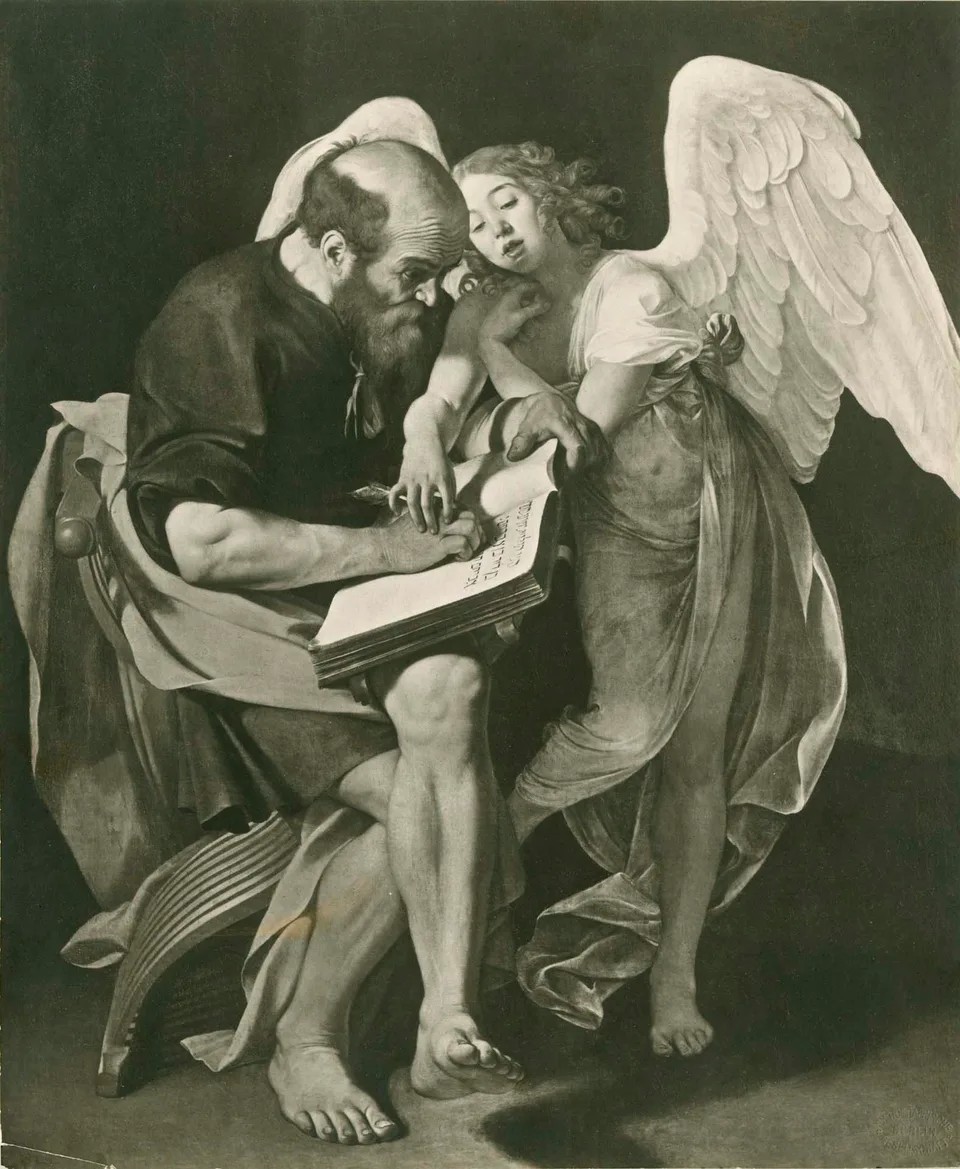
Between 14 and 18 May 1945, the control tower of the Friedrichshain flak tower complex in Berlin burned out. The Red Army had held the tower since 2 May. Inside were about 430 paintings from the Berlin Gemäldegalerie, the city’s state picture gallery. One was Caravaggio’s Saint Matthew and the Angel. On 18 May, museum staff saw civilians carrying smaller art objects out. The cause of the fire has never been explained.
Caravaggio painted the picture about 1602, in oil on canvas, 223 by 183 centimetres by the museum’s measure. The Berlin State Museums say it was made for the high altar of the Contarelli Chapel in San Luigi dei Francesi, Rome, and that the congregation rejected it. The saint looked like an unlettered peasant with bare, dirty feet, and the angel guided his hand. Vincenzo Giustiniani, a Roman banker and collector, bought it on condition that Caravaggio paint a second version. That version still hangs over the altar. Whether the first picture ever stood there is disputed. Finestre sull’Arte reported in 2017 an argument that its near-square shape, and the lack of church documents, suggest Giustiniani commissioned it directly.
Berlin bought the painting in 1815, with the Giustiniani collection. The newspaper taz reported in 1995 that the heirs had sold to Paris dealers in 1812, for about 150,000 francs. The museum confirms only the 1815 purchase. In 1925 the museum asked its photographer, Gustav Schwarz, to photograph the whole gallery, and his glass negatives survive. The Matthew is known only in black and white, and its colours are unknown.
From late 1941 the gallery moved its most important works into the tower. Sources differ on the start: the 1995 loss catalogue says September 1941, and the provenance researcher Regine Dehnel says January 1942. In March 1945 the best works were sent to salt mines in Thuringia, and US troops recovered them. About 430 paintings stayed, mostly large canvases that did not fit the mine lifts. The first floor of the tower burned on 6 May. The tower burned out fully between 14 and 18 May. The museum counts three Caravaggios among the losses.
The museum says the cause is unknown. German witnesses in 1945 spoke of plunderers or an unexplained fire. Soviet reports of July 1945 said there was reason to believe Germans set it, and one said thermite was used. Tagesspiegel reported in 2015 that German looters or young Nazis probably did it. Finestre sull’Arte blamed Soviet troops in 2017 and gave no source. No one has been charged or named.
The museum’s record, updated on 15 December 2025, says the painting was most likely destroyed. Survival is only a theory. In a 1990 book, Günther Wermusch, a former East German author who hunted lost treasures, argued that most paintings would have fitted the mine lifts and that the crate contents were never recorded. Rainer Michaelis, who compiled the 1995 loss catalogue, was sceptical, because no painting from the list had turned up at auction. In 2024 Francesca Cappelletti, director of the Galleria Borghese in Rome, told Il Messaggero that no detailed account exists of how the three Caravaggios were destroyed. She stated a hope, not a finding. Against this, the authors Akinsha and Kozlov have denied that the top Berlin works survived, Tagesspiegel reported. Dehnel says she is no longer sure that none survives. At least two small paintings from the gallery have come back.
In 2026 the Gemäldegalerie photographed about 430 glass negatives again and put them online in high resolution. No source reports a sighting of the Matthew.
Sources
- Berlin State Museums: object record for Saint Matthew and the Angel (inventory 365)
- Berlin State Museums: report on the lost paintings research page
- Dokumentation der Verluste, vol. 1 (1995): report on the Gemäldegalerie losses, page 14
- Regine Dehnel: report on the fate of the Gemäldegalerie works in the Friedrichshain flak tower (Predella 50, 2022)
- The Art Newspaper: Caravaggio and Rubens works destroyed by fire in Second World War are brought back to digital life (22 April 2026)
- Finestre sull'Arte: report on Caravaggio's lost Saint Matthew and the Contarelli Chapel (2017)
- taz: report on the missing Berlin paintings and the debate about their fate (1995)
- Tagesspiegel: report on the 2015 Berlin symposium on the Friedrichshain fires (2015)
- Il Messaggero: report on missing Caravaggio works, with Francesca Cappelletti (19 May 2024)
- National Gallery of Art Library: report on the Kaiser-Friedrich-Museum losses