 Stolen Art Dealer
Stolen · 22 October 2026
Three paintings taken from the Ducal Palace, Urbino
In February 1975 thieves took two Piero della Francesca panels and a Raphael from Urbino. Carabinieri found them in a Swiss hotel room 13 months later.
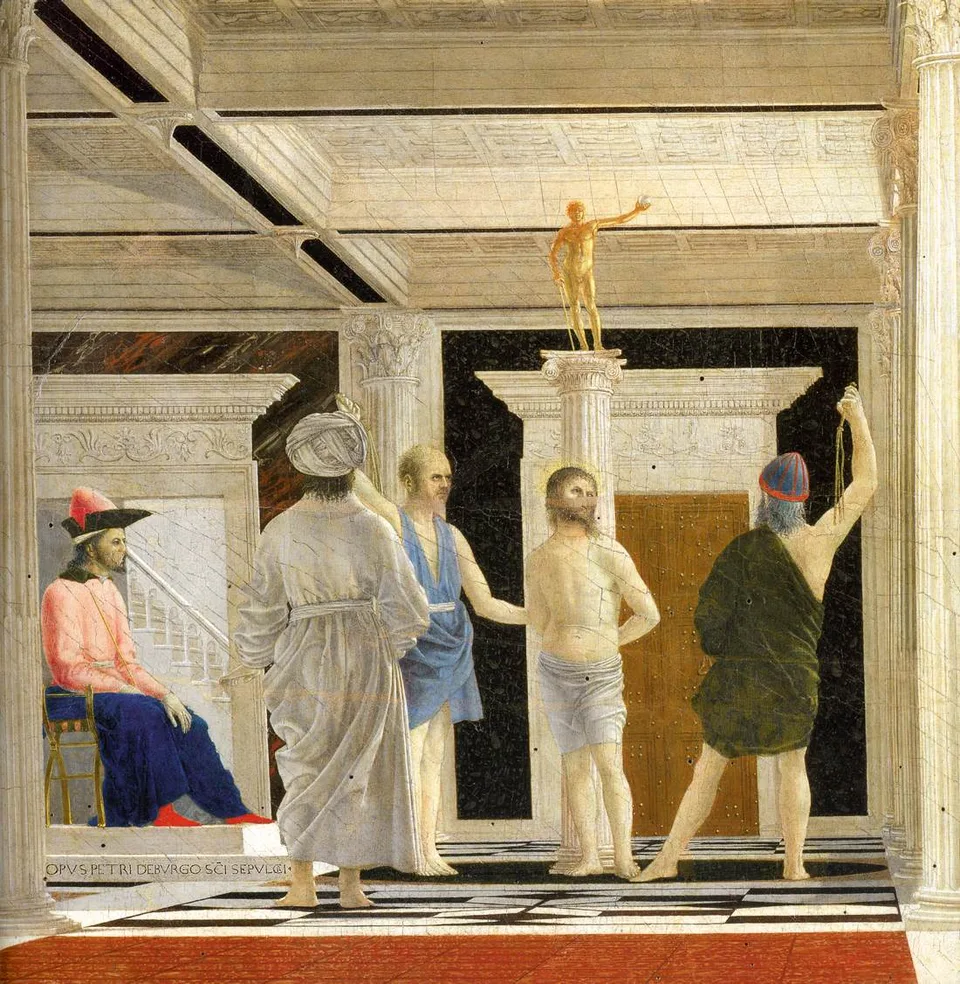
On the night of 5 to 6 February 1975, between half past midnight and half past two, thieves took three paintings from the Ducal Palace in Urbino, in the Marche region of Italy. The carabinieri, Italy’s military police, logged the theft that morning. Corriere della Sera and ANSA, the Italian news agency, report that the thieves climbed scaffolding that had been put up for building work. The museum had no alarm. General Roberto Riccardi, a carabinieri officer, writes that two guards were on night duty and that the thieves entered through the hanging garden beside the Sala degli Angeli.
The palace houses the Galleria Nazionale delle Marche. The thieves took two panels by Piero della Francesca and one by Raphael. The Flagellation of Christ is a tempera panel of 67.5 by 91 centimetres, signed by the painter. The museum dates it to 1459-1460, though other scholars place it anywhere from 1444 to 1472. The Madonna di Senigallia, from a church in Senigallia, had been in the gallery since 1917. Raphael’s Portrait of a Lady, known as La Muta, was painted in Florence around 1506 to 1507. It had come from the Uffizi on deposit in 1927, and the sitter is unknown.
Riccardi reports that a few days earlier the local superintendent had called the palace an impregnable fortress. The new Ministry of Cultural Heritage sent its minister, Giovanni Spadolini, to Urbino the same day. Many false leads followed: ransom calls, hoaxes and one man in Turin who gave himself up and named accomplices. La Stampa reported on 15 February 1975 that the estate agent he accused was arrested and then freed on 14 February because the evidence was weak.
The thieves could not sell such famous works and turned to ransom. The amount is disputed. Riccardi gives 250 million lire. A 1976 report in La Repubblica, cited in a press file, mentions 150 million. Il Ducato reports that carabinieri posed as buyers. On 23 March 1976 the carabinieri art squad and the Ticino cantonal police found all three paintings in a room at the Albergo Muralto in Locarno, Switzerland. Some accounts give 22 March. Corriere and ANSA, repeating a 2015 book written as a novel, say the thieves were about to destroy the paintings. That is a later account and is not proven. The paintings returned to Urbino by armoured van on 29 March, according to ANSA and Corriere. Riccardi gives 31 March.
One man is named in the sources used. Elio Pazzaglia, a carpenter from Pesaro, was arrested in 1976 and confessed. Corriere and ANSA say he was charged with four other men, including on counts of aggravated theft and receiving stolen goods. Il Resto del Carlino reported in 2020 that he alone entered the palace. On 27 May 1976 he escaped from Pesaro prison, La Stampa reported the next day. His recapture was not found. Accounts of who was held first do not agree. The sources used give no verdict and no sentence for any of the five.
The Flagellation and the Madonna di Senigallia are listed in the museum’s catalogue as stolen in 1975 and recovered in 1976. All three works are in the Galleria Nazionale delle Marche. WBUR reported that the Madonna di Senigallia travelled to the Museum of Fine Arts, Boston, in 2013 under escort by the carabinieri art squad.
Sources
- Corriere della Sera: report on the Urbino theft, forty years on (5 February 2015)
- ANSA: report on the Urbino theft, forty years on (5 February 2015)
- Il Giornale dell'Arte: report on the Urbino theft by Gen. Roberto Riccardi (2019)
- Movio, Ministry of Culture: catalogue entry on Piero della Francesca, The Flagellation (undated)
- Movio, Ministry of Culture: catalogue entry on Piero della Francesca, Madonna di Senigallia (undated)
- La Stampa: report on a false informant in the Urbino case (15 February 1975)
- La Stampa: report on an escape from Pesaro prison (28 May 1976)
- Il Resto del Carlino: report on the death of Ottavio Dall'Osso (8 June 2020)
- Il Ducato: report on a book about the Urbino theft (11 February 2015)
- WBUR: report on the Madonna di Senigallia in Boston (13 September 2013)