 Stolen Art Dealer
Stolen · 22 October 2026
The Eberswalde gold hoard, held in Moscow since 1945
Found in a clay pot in 1913, the Bronze Age gold went from Berlin to Moscow in 1945. It was filmed in a depot in 2004 and first shown in public in 2013.
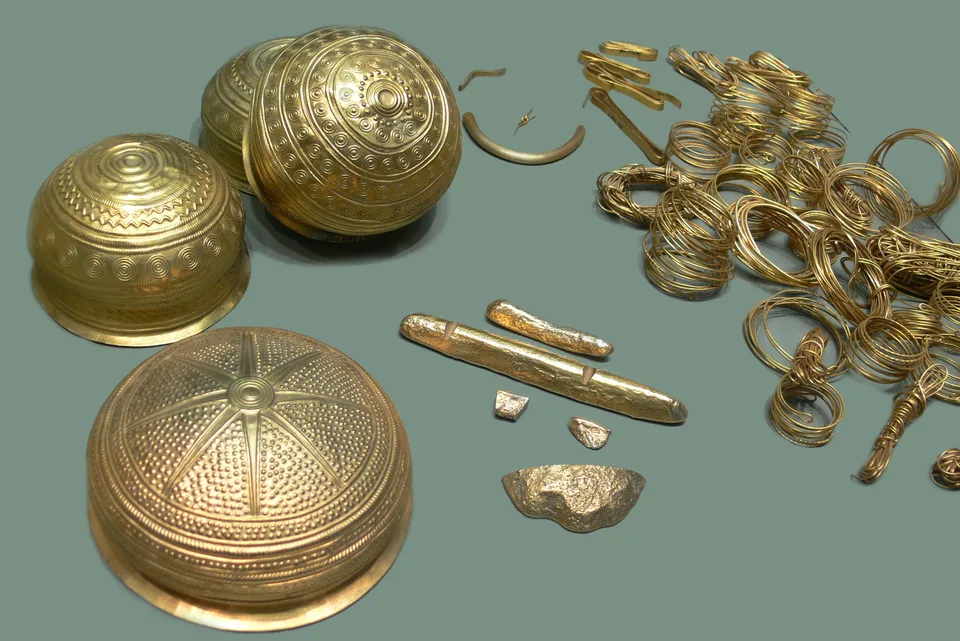
On Friday 16 May 1913, a labourer was digging about one metre down at a brass works settlement near Eberswalde, in Brandenburg. His tool broke a clay pot, and gold showed in the soil. This is the account in the record of Museum Eberswalde. The senior head of the firm told the head of the prehistoric department at the Berlin Ethnological Museum. Both men drove to the site on the Monday.
The museum expert listed 81 pieces, weighing 2.5945 kilograms. There were eight hammered gold bowls, neck and arm rings, wire spirals, an ingot and scrap gold. Sources date the hoard to about 900 BC, and range from the 11th to the 9th century BC. Der Standard and the Telegraph call it the largest prehistoric gold find in Germany. The firm’s head offered it to the emperor, Wilhelm II. It passed to the Prussian state in 1919 and stayed in the Berlin prehistory department. Der Standard reports that no German had seen it since 1942. The clay pot stayed in Berlin.
In 1945 Soviet trophy brigades took the hoard to the USSR. The Prussian Cultural Heritage Foundation, which Germany says owns it, states that German cultural goods were taken unlawfully. Welt reported in 2007 that it was one of three crates of gold from the Zoo flak tower bunker in Berlin, flown to Moscow and given to the Pushkin Museum. Museum Eberswalde gives the end of June 1945 as the arrival date. No second source confirms this.
For decades the hoard counted as lost. In January 2004, Spiegel wrote that Russia had denied for decades that it was in the Pushkin Museum. Spiegel TV filmed parts of the hoard in the museum’s secret depot, which the museum’s director opened herself. This was a press visit, not a public showing. Spiegel called the pictures the first clear proof. Other press puts the knowledge earlier. Der Standard wrote in 2002 that the location had been known for ten years, and Tagesspiegel wrote in 2005 that the gold appeared there in 1994.
The two sides rest on different law. The foundation cites the 1907 Hague Land War rules, which forbid taking cultural goods as reparation, and the 1990 and 1992 treaties with the USSR and Russia, which oblige return. A Russian law of the late 1990s makes these goods state property, as compensation for Soviet losses. The sources give different years for it. The museum’s director later called the trophy art a moral compensation for German destruction.
On 21 June 2013 the hoard went on public view for the first time since 1945. It was part of the exhibition Bronze Age: Europe without Borders at the Hermitage in St Petersburg, which moved to Moscow in October. The foundation says the show could not be held in Berlin because of the legal dispute. The Guardian reported that the opening was cancelled after Moscow objected to the German chancellor’s plan to mention looted works in her speech. The Telegraph reports that it went ahead after a first cancellation.
Museum Eberswalde says the originals are still in Russia, held by the Pushkin Museum as war booty. Its record was updated on 13 May 2025. The foundation says museum cooperation with Russia has been on hold since Russia’s war on Ukraine. Replicas are on view in Berlin and Eberswalde. No person is accused of a crime in these sources. The removal was a state act.
Sources
- Museum Eberswalde: record of the Eberswalde gold hoard (museum-digital, updated 13 May 2025)
- Der Standard: report on the Eberswalde demand for the gold hoard (15 Sep 2002)
- Spiegel: report on Spiegel TV filming the hoard in the Pushkin Museum depot (24 Jan 2004)
- Tagesspiegel: report on Eberswalde wanting its gold hoard back (2005)
- Welt: report on Moscow opening secret depots with Berlin gold (22 Jan 2007)
- Prussian Cultural Heritage Foundation: cultural goods displaced by the war in Russia
- Prussian Cultural Heritage Foundation: press release on the Hermitage exhibition (18 Jun 2013)
- The Guardian: report on the Russia-Germany row over the war-loot exhibition (21 Jun 2013)
- The Telegraph: report on the Eberswalde hoard (2013)
- Der Spiegel: interview with the head of the Pushkin Museum (13 Jul 2012)
- Deutsche Welle: interview with the head of the Pushkin Museum (8 Mar 2016)
- Prussian Cultural Heritage Foundation: German-Russian museum dialogue