 Stolen Art Dealer
Stolen · 22 October 2026
Kirchner's Berlin Street Scene: returned, then sold
In 2006 Berlin returned a Kirchner to the heirs of the collector Alfred Hess. Whether the 1936 sale was forced is disputed. Christie's sold the painting for $38,096,000.
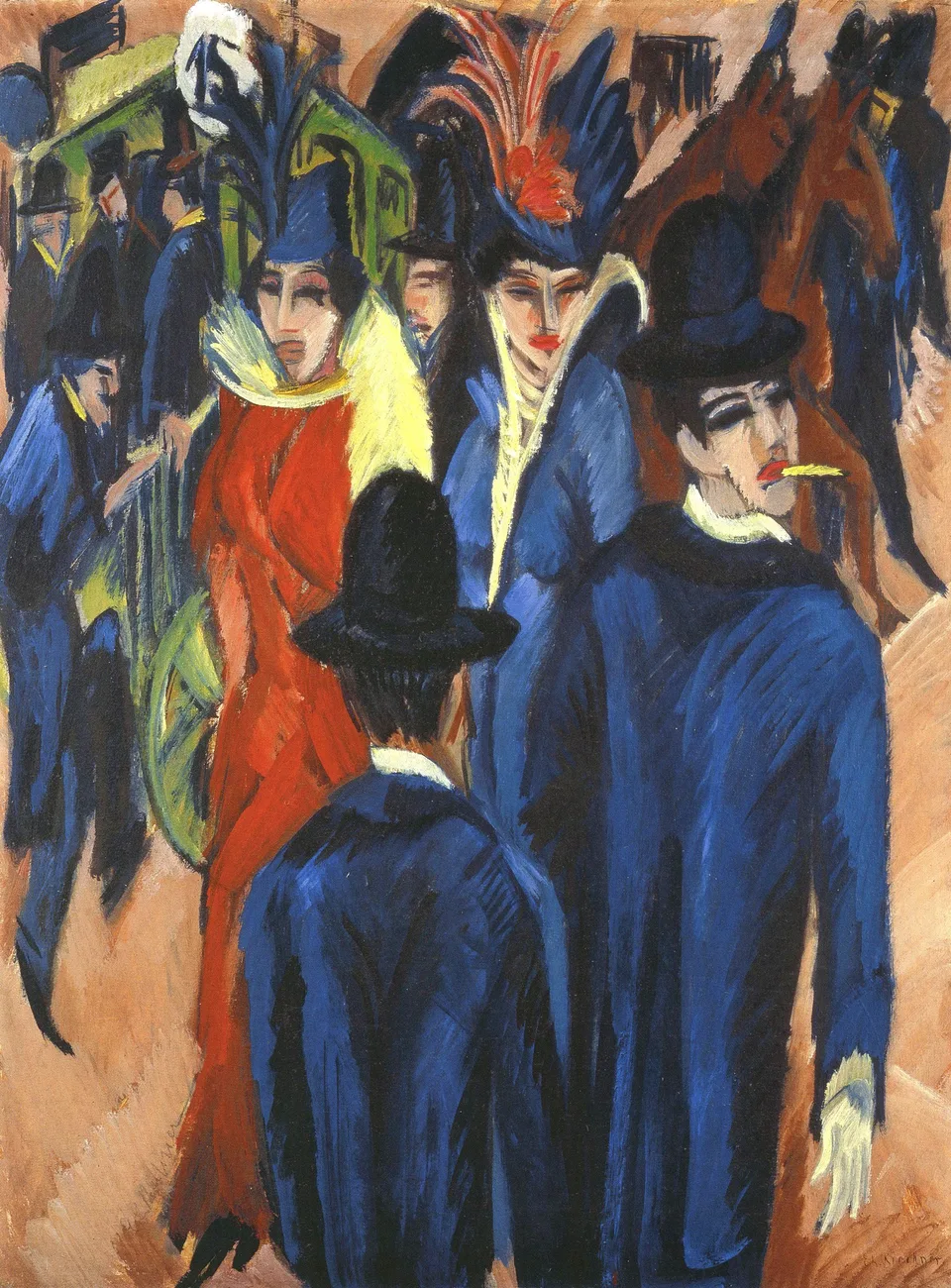
On 1 August 2006 Kirchner’s Berlin Street Scene came off the wall of the Brücke-Museum in Berlin, where it had hung since 1980. Spiegel International gives that date. The Berlin government had announced on 27 July that it would return the painting to the heirs of Alfred Hess, the collector who once owned it.
Ernst Ludwig Kirchner painted the work in 1913 and 1914. Christie’s gives it as oil on canvas, 121.6 by 91.1 centimetres, with a second picture, Trees, on the back. Alfred Hess was a Jewish shoe manufacturer in Erfurt and an early collector of German Expressionism. When he died in late 1931, the painting passed to his only heir, his son Hans. Hans lost his job at the Ullstein publishing house in June 1933, “for racial reasons”, according to a certificate that the Berlin administration quoted. He left Germany that year. His mother Thekla kept the collection in trust, and it went to Switzerland. In 1961 a Berlin compensation office recognised Hans Hess as a victim of Nazi persecution and awarded him 75,000 Deutschmarks.
In 1936 Thekla Hess sent seven paintings, this one among them, from Zurich to the Kölnischer Kunstverein, an art association in Cologne. Carl Hagemann, a collector in Frankfurt, bought it from the association for 3,000 Reichsmark, at the end of 1936 or early in 1937. The Brücke-Museum bought it in 1980 for 1.9 million Deutschmarks.
Whether the 1936 sale was forced is disputed. In a sworn statement in 1958, Thekla Hess said that two Gestapo officials from Nuremberg threatened her one evening in 1936 and made her bring the collection back to Germany. In 1961 Hans Hess said that she had no choice but to sell, often below market value, in order to live. The Berlin administration said it could prove neither that she received an adequate price and could use it freely, nor that the sale would have happened without Nazi rule.
The Kirchner Archive in Davos, the Brücke-Museum’s friends’ circle and the dealer Villa Grisebach disagreed. On 16 August 2006 they said the history had nothing to do with Nazi persecution. They argued that the family sold works from 1930 for money, that Thekla Hess sent the painting back freely, and that 3,000 Reichsmark was a good price. The lawyer Lutz von Pufendorf, a former Berlin culture state secretary, still held that view in 2018. Deutschlandfunk, a German public radio station, argued that the Gestapo pressure showed the painting was taken under Nazi pressure. artnet called the evidence “inconclusive”, since no receipt was found.
Lawyers for Anita Halpin, Alfred Hess’s granddaughter, wrote to the Berlin authorities in autumn 2004. The city tried first to buy the painting or pay compensation. It returned the work under the 1998 Washington Principles, which are not legally binding. Critics called the Senate’s conduct amateurish and the return needless. Berlin replied that the claim could not be refuted under the rules.
Christie’s sold the painting in New York on 8 November 2006, as lot 37, for $38,096,000 including the buyer’s premium. It was a new auction record for Kirchner. The buyer was the Neue Galerie New York. Criminal complaints were filed in 2006 against Berlin officials and against Halpin and her lawyers, who deny wrongdoing. Welt reported in 2018 that the inquiries into the officials ended without result. The sources do not give the outcome of the complaint against Halpin and her lawyers. The Neue Galerie showed the work in 2007 under the credit line “Neue Galerie New York and Private Collection”. Sole ownership is not confirmed.
Sources
- Berlin House of Representatives: culture committee minutes on the Kirchner return (28 Aug 2006)
- Der Spiegel: report on the Kirchner return being lawful (2006)
- Welt: report on the critics' letter on the Kirchner return (Aug 2006)
- Welt: report on the Kirchner case and restitution (2018)
- Deutschlandfunk: report by Stefan Koldehoff on the Kirchner case (23 Aug 2006)
- artnet: report by Anna Blume Huttenlauch on the Kirchner sale (8 Nov 2006)
- Christie's: press release on the 8 November 2006 sale
- Los Angeles Times (AP): report on the Christie's sale (9 Nov 2006)
- Neue Galerie New York: exhibition page, Kirchner: Berlin Street Scene (2007)