 Stolen Art Dealer
Stolen · 22 October 2026
The Guelph Treasure and the 1935 sale
In 1935 Prussia bought 42 pieces of medieval goldwork from Jewish dealers. Whether that sale was forced is disputed, and the claim is still open.
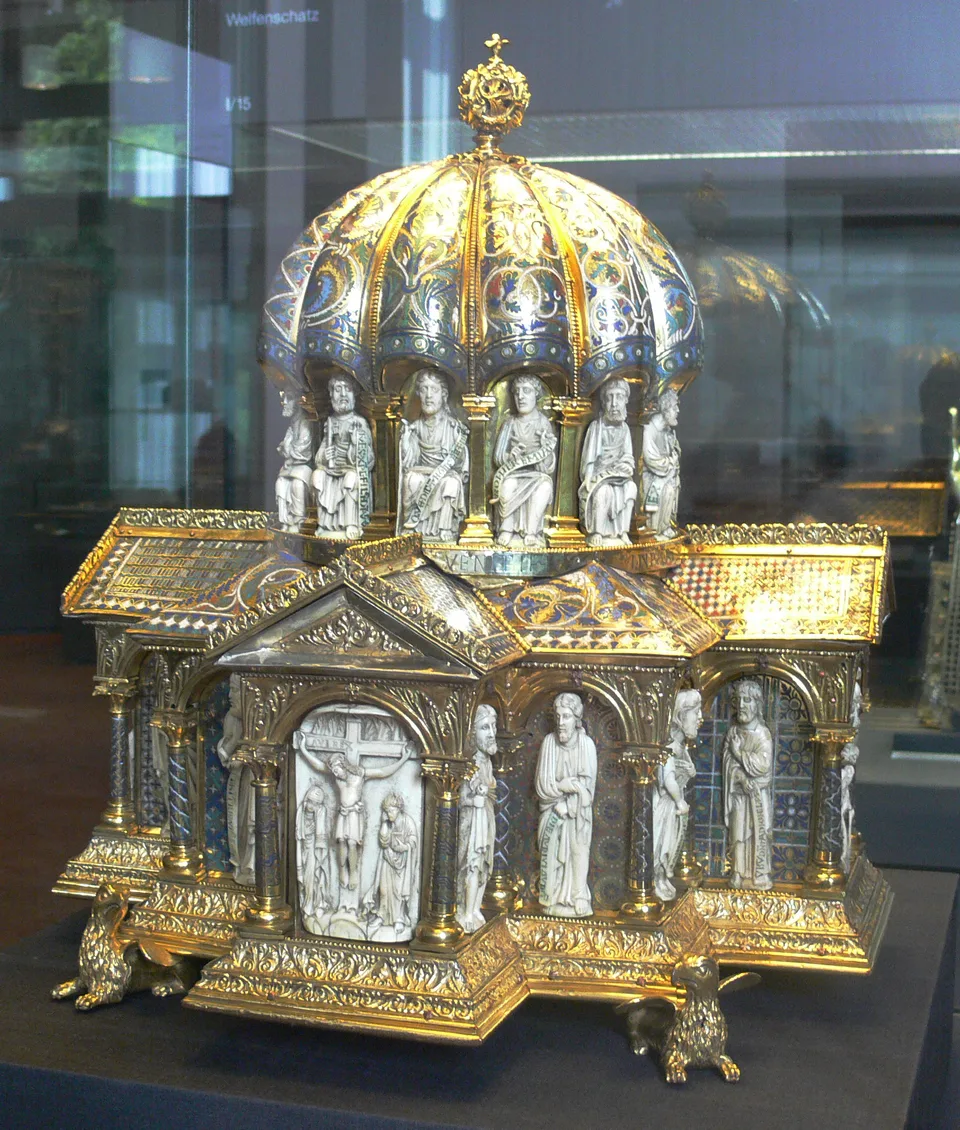
On 14 June 1935 a contract was signed for the sale of 42 pieces of medieval church goldwork, known as the Guelph Treasure. The buyer was Dresdner Bank, which the Advisory Commission says was secretly acting for the State of Prussia. The price was 4.25 million Reichsmarks. The pieces went to Berlin. Whether the sale was forced is disputed.
The Guelph Treasure is a group of reliquaries, portable altars and crosses made between the 11th and 15th centuries for the cathedral church of St Blasius in Brunswick. The House of Brunswick-Lüneburg, the Welf family, owned it from 1671. Its most valuable piece, ARTnews and The New York Times report, is a 12th-century dome reliquary made in Cologne of gold, silver and copper, with walrus-ivory figures.
On 5 October 1929 a group of Jewish art dealers from Frankfurt, among them the firm J.S. Goldschmidt, bought 82 pieces for 7.5 million Reichsmarks. Foreign and domestic partners joined them in a consortium, whose agreement the Commission says was never found. In 1930 and 1931 the dealers sold 40 pieces, mostly in the United States. The other 42 were stored in Amsterdam. In April 1935 the dealers asked 5 million and the bank offered 3.7 million.
The two sides now give different accounts. On 20 March 2014 the Commission, a German body that mediates in Nazi-looted art disputes, found that this was not a sale forced by persecution, and it did not recommend return. It found no sign that the dealers were pressured, for instance by Hermann Göring, then Prussian Prime Minister,. The Prussian Cultural Heritage Foundation (SPK), which holds the collection, says the price matched a weak market. The heirs say Göring drove the sale, that the bank and the Prussian government used the dealers’ weak position, and that the collection was worth at least 6 to 7 million Reichsmarks. Göring appears here only as the heirs’ allegation. No source gives a US dollar value for the 1935 price.
The heirs went to court. In 2008 they asked the SPK to return the pieces. In February 2015 three heirs, Alan Philipp, Gerald Stiebel and Jed Leiber, sued Germany and the SPK in Washington. On 3 February 2021 the US Supreme Court ruled 9 to 0 that a state’s taking of its own nationals’ property is not a violation of international law. It did not decide whether the sale was genocide, and it sent the case back to the lower courts. In August 2022 the district court found that US courts had no jurisdiction. The appeals court upheld the dismissal in July 2023. ARTnews dates the ruling 13 July and the SPK 15 July.
In 2022 heirs of Alice Koch, a Jewish consortium member who had not been part of the first procedure, gave the SPK new documents. The SPK and Deutsche Welle agree that they show she paid Reich flight tax, a levy on Jews who emigrated, in October 1935 and soon left for Switzerland. The SPK says the documents do not change its view of the sale. The claimants, and The New York Times in March 2025, read them as pointing to duress. In 2024 two groups of heirs asked the Commission again, and on 3 March 2025 the SPK agreed to a new procedure.
On 1 December 2025 a binding arbitration tribunal for Nazi-looted art replaced the Commission, which had not decided the case. The collection is still in the Kunstgewerbemuseum in Berlin. The dpa news agency reported on 27 November 2025 that the case was undecided. The heirs’ lawyer Markus Stoetzel doubted its independence.
Sources
- Advisory Commission: recommendation on the Guelph Treasure (20 March 2014)
- Staatliche Museen zu Berlin: report on the Commission's recommendation (March 2014)
- Supreme Court of the United States: opinion in Federal Republic of Germany v. Philipp (3 February 2021)
- ARTnews: report on the dismissal of the Guelph Treasure lawsuit (18 July 2023)
- Prussian Cultural Heritage Foundation: report on the Guelph Treasure (5 February 2025)
- Prussian Cultural Heritage Foundation: report on a new Commission procedure (3 March 2025)
- Deutsche Welle: report on the Guelph Treasure (10 February 2025)
- The New York Times: report on the Guelph Treasure (19 March 2025)
- BZ Berlin, citing dpa: report on the Guelph Treasure dispute (27 November 2025)