 Stolen Art Dealer
Stolen · 22 October 2026
Klimt's Gertrud Loew: from Vienna to two London sales
Gertha Felsovanyi fled Vienna in 1939 and left Klimt's portrait of her behind. A 2014 settlement with her heirs led to sales at Sotheby's in 2015 and 2026.
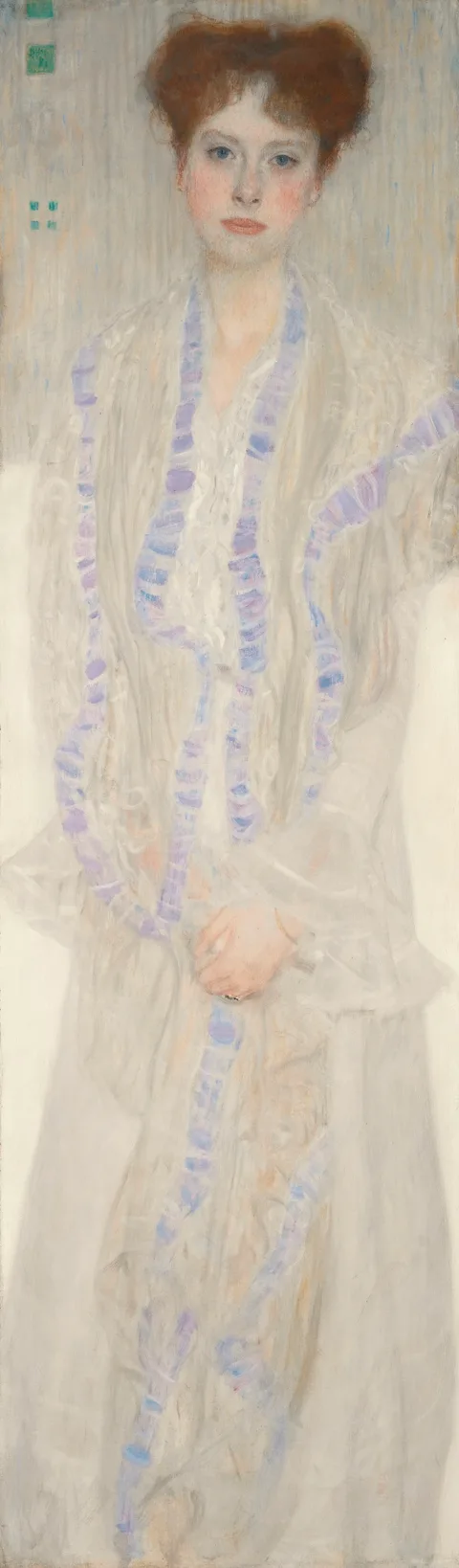
In 1938 Gustav Klimt’s full-length portrait of Gertrud Loew still hung in her flat in Vienna. She was known as Gertha, and by then she was Gertha Felsovanyi, a widow who ran the family sanatorium, a private clinic. In 1939 she fled to the United States. The Anschluss, the German takeover of Austria, had come the year before. The painting did not go with her. By 1942 it was with the film director Gustav Ucicky.
Klimt painted the portrait in 1902, when Gertha was 19. It is an oil on canvas, about 150 centimetres high and 45 wide. Her father, Dr Anton Loew, who directed the sanatorium, commissioned it. Sotheby’s says it was shown at the Vienna Secession in 1903 and 1904, where the critic Ludwig Hevesi praised it. The Guardian reports that Gertha was first refused entry to the United States. She was allowed a day pass at Christmas 1939 to see her son Anthony, through the intercession of Eleanor Roosevelt. She received a visa in 1940 and died in California in 1964.
Ucicky, born in 1899, made films in the Nazi era, including propaganda films. He was long said to have been Klimt’s son. Sotheby’s says he acquired the portrait around 1941. How he acquired it has not been reconstructed. Ucicky died in 1961 and was never charged over the painting. His widow, Ursula, inherited his collection. Der Standard reports that Anthony Felsovanyi tried for years to recover the portrait, and that his letters to her went unanswered. He died in 2013, aged 98 or 99.
Ursula Ucicky founded the Klimt Foundation in September 2013 and gave the portrait to it. In January 2014 the foundation and the heirs named three independent legal experts, led by Clemens Jabloner, a former president of Austria’s Administrative Court. On 10 September 2014 they found, unanimously, that the painting would have to be restituted if Austria’s art restitution law applied. The foundation is a private body and is not bound by that law, but said it would follow the Washington Principles of 1998. The panel presumed a purchase in the Nazi era. Jabloner said the question was not whether Ucicky had acted badly.
The foundation and the heirs agreed a settlement. Its terms are confidential. The painting was to be sold and the proceeds shared. Der Standard wrote that the split was, reportedly, half and half. The Guardian wrote only that the two sides agreed to divide the proceeds.
Sotheby’s offered the portrait in London on 24 June 2015, as lot 26, with an estimate of 12 to 18 million pounds. It sold for 24,789,000 pounds, including the buyer’s premium. Reuters gave about $39.1 million at the time. Two bidders competed for it, and the buyer was not named then.
The portrait came back to Sotheby’s London on 24 June 2026, in a sale of works from the Lewis Collection. The 2026 lot page lists the seller as the owner who bought it in 2015. The estimate was 20 to 30 million pounds. It sold for about 36.2 million pounds, including the buyer’s premium. Sotheby’s gives $47.9 million, its own conversion. The Art Newspaper reports seven bidders and an Asian private collector as the buyer, whose name has not been published.
Sources
- Sotheby's: Gustav Klimt, Bildnis Gertrud Loew, lot 26 (24 June 2015)
- The New York Times: report on the Klimt portrait sale (24 June 2015)
- The Guardian: report on the Klimt portrait and its history (4 June 2015)
- Der Standard: report on the Klimt Foundation settlement with the Felsovanyi heirs (2 June 2015)
- ORF Wien: report on the legal experts' finding (10 September 2014)
- Klimt Foundation: provenance research on the portrait of Gertrud Loew
- Reuters: report on the 2015 Sotheby's London sale (24 June 2015)
- Sotheby's: Gustav Klimt, Bildnis Gertrud Loew, lot 16 (24 June 2026)
- The Art Newspaper: report on the Lewis Collection evening sale (25 June 2026)