 Stolen Art Dealer
Stolen · 22 October 2026
Memling's Last Judgment, taken three times
A privateer took Hans Memling's Last Judgment at sea in 1473. Napoleon's agents and the Red Army also removed it. It is now in Gdańsk.
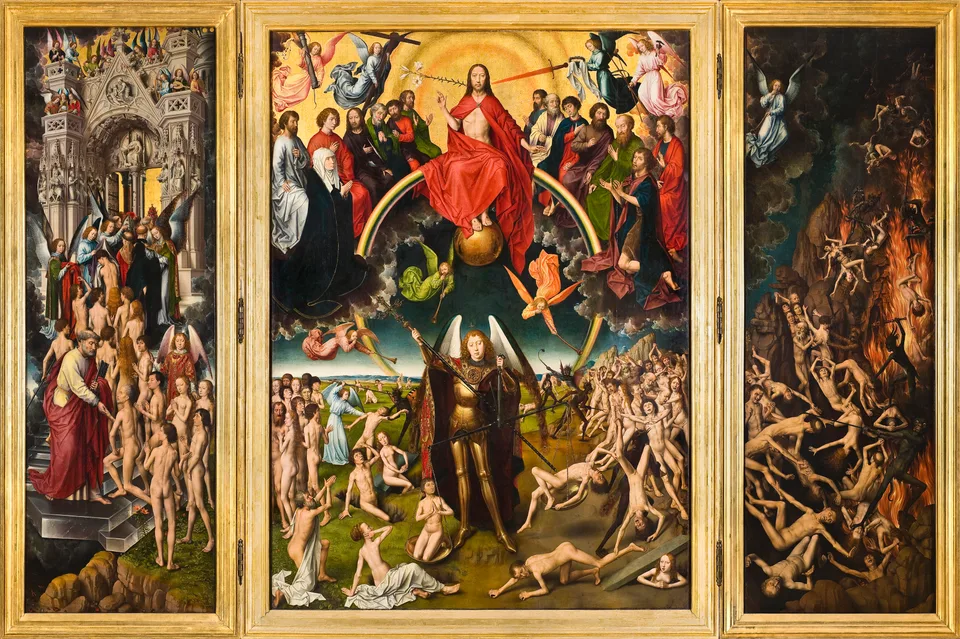
In the spring of 1473 a ship sailed from Bruges for Italy with a large altarpiece in its hold. Privateers from Gdańsk, then a Hanseatic port on the Baltic, attacked it at sea. One academic essay gives the date as 27 April, off Dunkirk. The altarpiece was Hans Memling’s Last Judgment.
Memling painted the triptych in Bruges between 1467 and 1473. Angelo Tani, a Florentine banker who ran the Medici bank’s Bruges branch, ordered it for a family chapel near Florence. The National Museum in Gdańsk says it never arrived and that Tani likely never saw the finished work. The picture is unsigned. For centuries people credited it to other painters. Aby Warburg’s study of 1901 and 1902 made the case for Memling, and most researchers now agree.
The museum names the captured ship as the galleon San Matteo and says it was towed to Stade, near Hamburg. The essay calls it a galley and says it was taken toward Hamburg. The captain was Paul Beneke of Gdańsk. The museum says the triptych went to three Gdańsk patricians who owned the ship. They gave it to St Mary’s Church. The essay says Beneke gave it to the church himself. Charles the Bold, Duke of Burgundy, demanded the cargo back. This failed. Pope Sixtus IV also demanded return or compensation, but the essay says his letter did not reach Beneke before he died in 1477. Beneke was never tried. The essay says he told a Hamburg inquiry that he held a letter of marque, and that the explanation was accepted.
The painting stayed in St Mary’s for more than three centuries. The museum, citing a French diplomat, says Emperor Rudolf II offered 40,000 thalers for it. Gdańsk refused, and it refused Tsar Peter I in 1716 and 1717. In 1807 Napoleon’s army occupied the city. Dominique Vivant Denon, who ran the Musée Napoléon, took the best art for the Louvre. The triptych hung there as no. 563, labelled a work by Jan van Eyck. After the French defeat it left the Louvre in 1815 and went to Berlin. The King of Prussia had promised it to St Mary’s. It reached Gdańsk in January 1817.
The next loss came with the Second World War. Willi Drost, director of the city museum, moved it in 1942 to a church at Meiserwalde, now Mierzeszyn. In September 1944 he sent it into Germany, to a village church in the Rhön mountains in Thuringia. The essay names the church as Helmerhausen and says “probably”. The museum says the Red Army found it in 1946 and sent it to the Hermitage in Leningrad. The essay says it was shown there on 9 May 1956.
The museum dates the return to Poland to 1956. The essay says it reached Gdańsk on 21 September 1956, after a commission led by Stanisław Lorentz, director of the National Museum in Warsaw, visited the Soviet Union. The essay says the exact circumstances are not known. The museum’s home page says 1957, and other sources give 1958. The painting went to Warsaw first, for research and restoration. It now hangs in the National Museum in Gdańsk. The essay says a copy hangs in St Mary’s.