 Stolen Art Dealer
Stolen · 22 October 2026
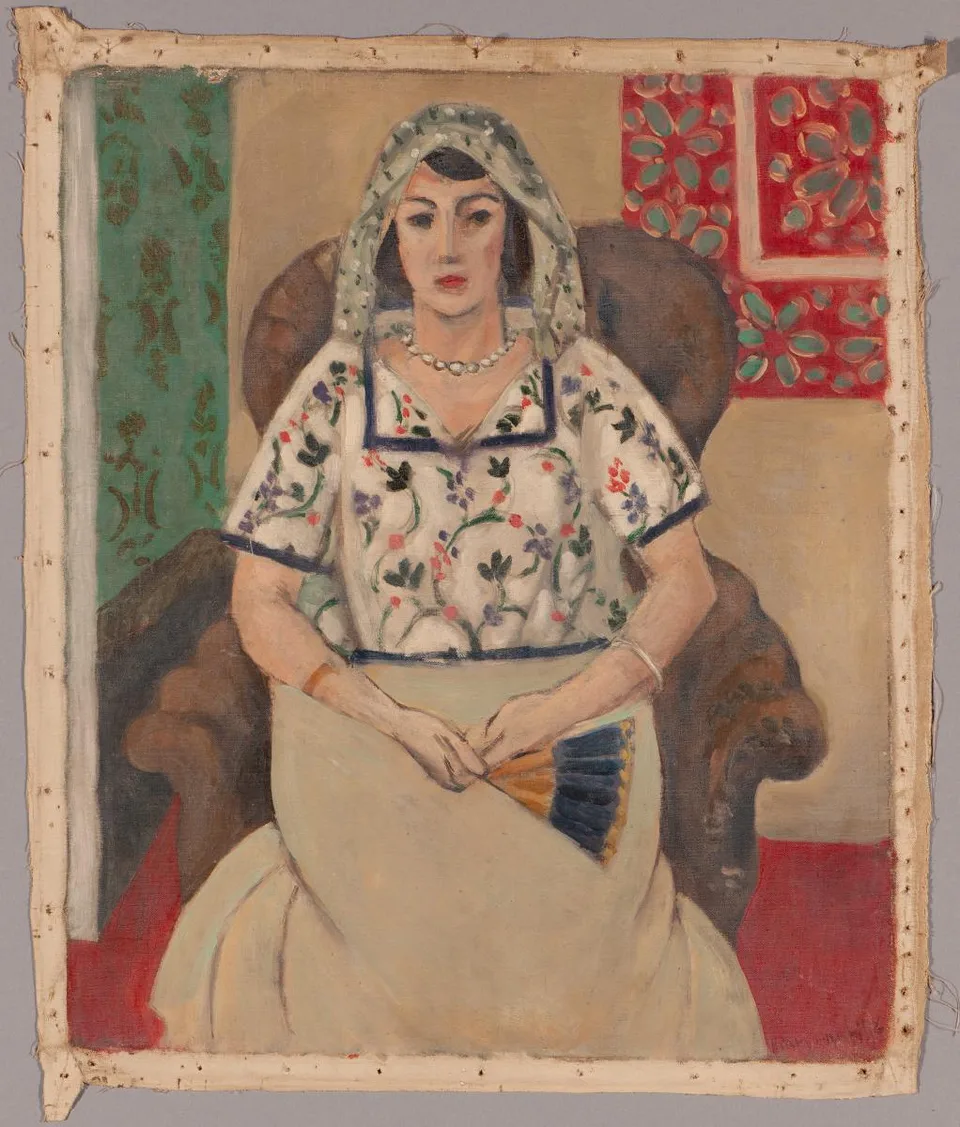
Matisse's Seated Woman, returned to the Rosenberg heirs
Seized in occupied France, a small Matisse resurfaced in Cornelius Gurlitt's Munich flat and went back to Paul Rosenberg's heirs in May 2015.
On 5 September 1941, German authorities opened a rented safe at a bank in Libourne, a town in the Gironde near Bordeaux. They took 162 works. The safe, box number 7, was Paul Rosenberg’s. He was a leading Paris dealer in modern art, with galleries in Paris, London and New York, and he represented Matisse, Picasso and Braque. His family had left Paris in June 1940 and emigrated to New York that September. Sources disagree on which German unit opened the box.
The painting in this story is a small oil, about 55 by 46 centimetres, of a woman in a patterned blouse with a fan in her lap. Lost Art dates it to 1921. The Kunstmuseum Bern dates it to 1923. A receipt in the Rosenberg archive shows he bought it from the dealer Georges Bernheim for 8,000 francs in 1923. It was shown in Paris in 1931 as his. No document places it in the Libourne box.
In 1942 the Einsatzstab Reichsleiter Rosenberg, a Nazi unit that took art in occupied countries, listed the picture and tagged it “unknown”. That tag cut the link to its owner. On 24 July 1942 the unit’s Paris head, Kurt von Behr, traded it to the Paris dealer Gustav Rochlitz in an exchange of works.
The route from 1942 to the Gurlitt family is only partly documented. The Kunstmuseum Bern record says Hildebrand Gurlitt, a German dealer who handled art for the Nazis, had it by 10 November 1942 and sold it that day to the Paris dealer Raphael Gerard. It says Gurlitt held it again from September 1953 at the earliest, until he died in 1956. Earlier reports gave 1944. The task force that studied the picture said the path survives only in fragments. By inheritance it passed to his widow Helene, then to their son Cornelius in 1968.
In early 2012, Augsburg prosecutors searched Cornelius Gurlitt’s Munich flat in a tax inquiry. They found about 1,280 works, this one unframed. The find stayed secret until the magazine Focus reported it in November 2013. That month Elaine Rosenberg, Paul’s daughter-in-law, saw a grainy slide of the painting and knew it. The New York Times reports that she called her lawyer, Christopher Marinello. In March 2014 Gurlitt’s side agreed to return it, but the hand-over failed, and a second claimant, never named, came forward. Gurlitt died on 6 May 2014, aged 81, and the tax inquiry closed. He left his estate to the Kunstmuseum Bern.
On 12 June 2014 the German-Bavarian task force Schwabinger Kunstfund, led by Ingeborg Berggreen-Merkel, found the Matisse to be Nazi-looted art from the Rosenberg collection. It was the first such work found in the trove. The task force found a very high probability that this was Rosenberg’s picture, and said it could not show with last certainty how Hildebrand Gurlitt obtained it. West Germany had compensated the family in 1960 for a Matisse “Femme assise”, number 1721 in Rosenberg’s inventory.
Culture Minister Monika Grütters signed the restitution agreement on 24 March 2015. A Munich court approved the release on 12 May. On 15 May 2015 the painting was handed to Marinello for the family, one of the first two works returned from the trove. Rosenberg’s granddaughter, the journalist Anne Sinclair, told NPR she was moved and sad that her grandfather could not see it. About 400 works were taken from his collection, and NPR reports that about 60 are still unaccounted for. The Kunstmuseum Bern database lists the Matisse as in private ownership.
Sources
- The New York Times: report on the Matisse Femme assise and the Gurlitt collection (16 May 2015)
- NPR: report on the Matisse Seated Woman to be reunited with the Rosenberg heirs (15 May 2015)
- Task Force Schwabinger Kunstfund: final report on Matisse, Femme assise (2014)
- German Lost Art Foundation: Lost Art database entry for Femme assise dans un fauteuil (ID 477894)
- Kunstmuseum Bern: Gurlitt database record for Matisse, Femme assise
- BBC: report on the death of Cornelius Gurlitt and the Matisse finding (2014)
- BBC: report on the agreement to return the Matisse (24 March 2015)