 Stolen Art Dealer
Stolen · 22 October 2026
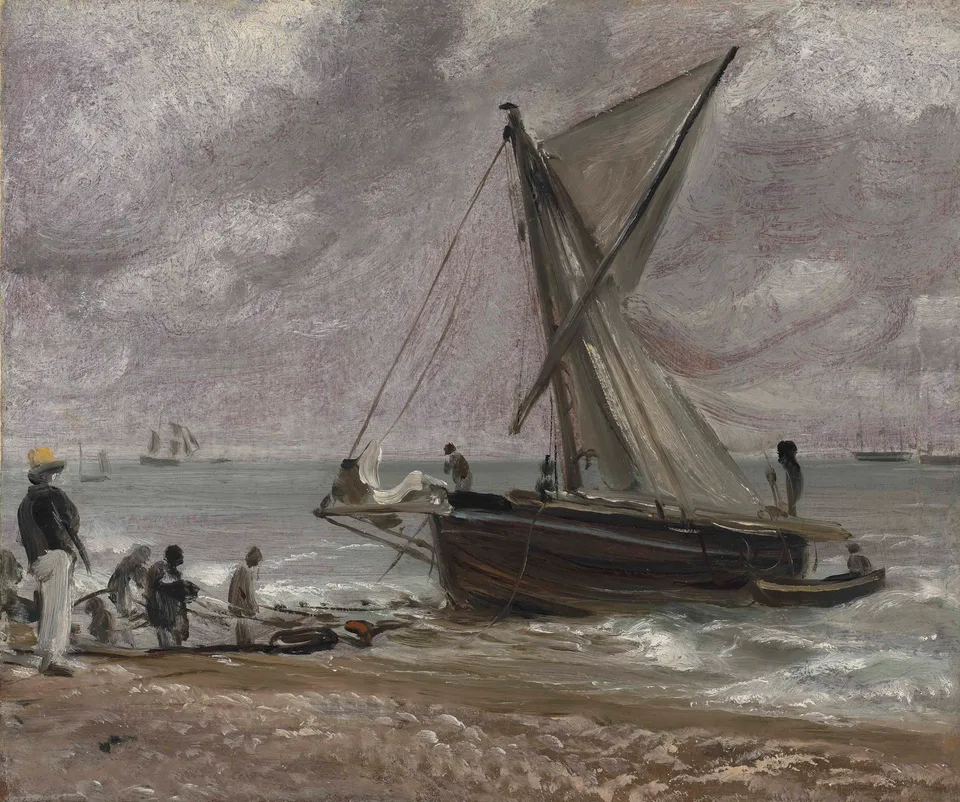
A Constable sketch of Brighton, returned by the Tate
Looted in Hungary in 1944 or 1945, Constable's small Brighton sketch was given to the Tate in 1986. It went back to Baron Hatvany's heirs in 2016 and sold at Christie's.
In March 1944 German forces occupied Hungary. Baron Ferenc Hatvany, a Budapest collector and painter of Jewish origin who had converted to Christianity, went into hiding with false papers. His properties were confiscated, and witnesses saw German military trucks load goods at his castle. The Panel later found that a small Constable sketch from his collection was probably taken at that time, before Soviet troops took Budapest in February 1945.
John Constable painted Beaching a Boat, Brighton in 1824, on one of his first visits to the town. It is an oil sketch on paper laid on canvas, about 26 by 30 centimetres. He drew on its motifs for his large Chain Pier, Brighton of 1827, now in Tate Britain. The sketch passed to his daughter and was sold at Christie’s in 1892. Hatvany, whose family wealth came from banking and industry, bought it at a Paris sale in May 1908. His collection centred on 19th-century French art.
In 1942, because of Allied bombing, he had moved most of his works into Budapest bank vaults under a non-Jewish name. The Art Newspaper reports, from the claimants, that the Constable went into the vault of the Hungarian General Credit Bank. The Spoliation Advisory Panel, a UK body that advises on claims for Nazi-era losses, found it unclear whether the painting was in a vault or in one of his homes.
Who took it is disputed. The Panel found that German forces probably took it, in the course of antisemitic persecution. It thought a Soviet taking less likely, because that would more probably have sent the work to the Soviet Union. The claimants’ account, as The Art Newspaper gave it in 2014, is that the vault was looted in 1945, probably by individual Soviet soldiers. The claimants’ evidence, which the Panel accepted, records the family’s suffering: Hatvany’s son was murdered, his sister and her husband died at Auschwitz-Birkenau, and his mother-in-law was killed by members of the Arrow Cross, a Hungarian fascist movement. Hungary’s own commission listed the painting as no. 768 on its register of works looted from him in 1946 to 1948. He left Hungary and died in 1958.
The sketch next appears in London in 1962. A private buyer acquired it that year and offered it to the Tate in 1985, and the trustees accepted the gift in January 1986. Hatvany’s heirs told the Tate of their claim in April 2012. The Tate first opposed it. In March 2014 the Panel, which had withheld the claimants’ name, recommended return. The Art Newspaper named Hatvany that month. The trustees authorised the return in May 2014.
Soon afterwards the Museum of Fine Arts in Budapest told the Tate of a 1946 export licence for a Constable “Fishing Boat” of nearly the same size. The Tate paused the return. In a supplementary report of 10 September 2015, the Panel found no link between Hatvany and the two names on the licence. On the balance of probabilities he had not recovered the painting, and its recommendation stood. The return was conditional on the heirs repaying West Germany its share of earlier compensation, and the sum was agreed.
The Tate handed the painting over in 2016. Christie’s lists the restitution in 2016; a 2017 report in The Art Newspaper gives 2015, the year of the Panel’s decision. Christie’s sold it in London on 8 December 2016 for 665,000 pounds, including the buyer’s premium, about $840,560 at Christie’s rate. The estimate was 500,000 to 800,000 pounds. The buyer was not named, and no source found gives where the sketch is now.
Sources
- UK Government: report of the Spoliation Advisory Panel on a Constable painting in the Tate Gallery (26 March 2014)
- UK Government: Spoliation Advisory Panel rules on return of Constable painting (26 March 2014)
- UK Government: supplementary report of the Spoliation Advisory Panel on the Constable painting (10 September 2015)
- Spoliation Advisory Panel: supplementary report HC 439 (10 September 2015)
- The Art Newspaper: report on the Nazi loot claim for the Tate's Constable (2014)
- The Art Newspaper: report on the Tate holding the return of the Constable (30 April 2015)
- The Art Newspaper: report on the new Panel report on the Constable (10 September 2015)
- The Art Newspaper: report on the returned Constable heading to Christie's (10 November 2016)
- The Art Newspaper: report on UK restitution powers (13 September 2017)
- BBC News: report on the Tate and the Constable painting (27 March 2014)
- Christie's: lot 25, John Constable, Beaching a Boat, Brighton (8 December 2016)
- Christie's: press report on the Old Master and British Paintings Evening Auction results (8 December 2016)