 Stolen Art Dealer
Stolen · 22 October 2026
Liebermann's Two Riders on the Beach, returned in 2015
A Liebermann owned by David Friedmann of Breslau was lost to Nazi persecution, resurfaced in the Gurlitt trove, and was returned to his heirs, who sold it in London in 2015.
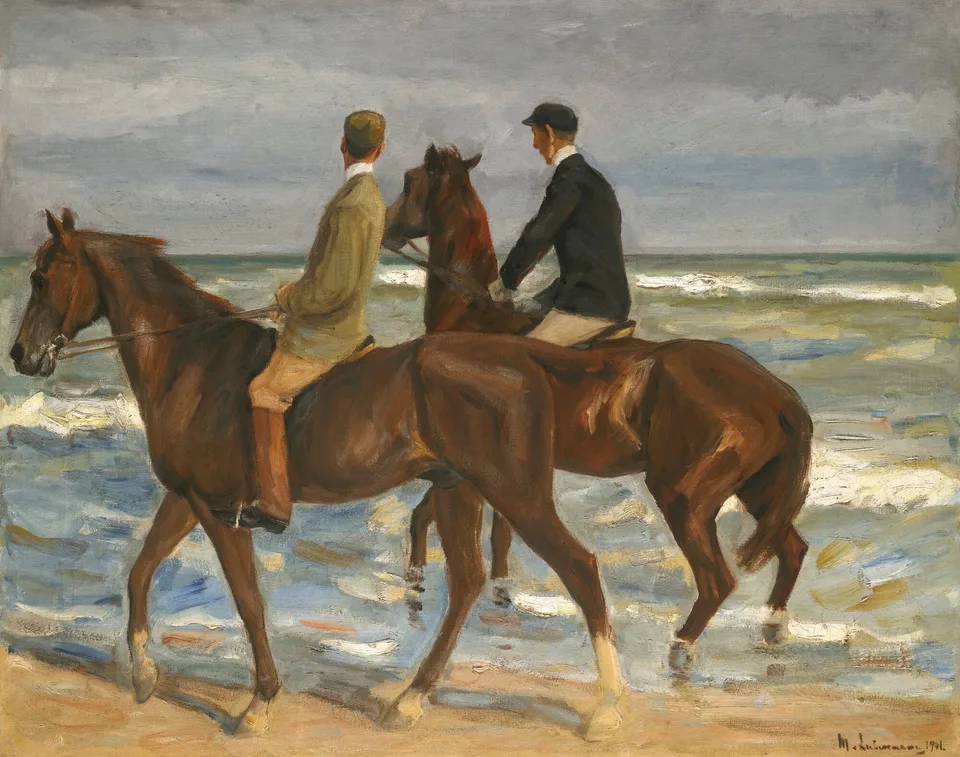
On 5 December 1939 an official in Breslau, named Westram, wrote to the Reich economics minister. He asked how the art of wealthy Jews should be taken. The German Task Force that later studied this painting says his letter names a Liebermann, Two Riders on the Beach, owned by David Friedmann. Friedmann was a Jewish businessman, industrialist and collector who lived in Breslau. The official also barred him from selling anything without permission.
Max Liebermann painted the oil on canvas in 1901, after studies made at Scheveningen, and showed it that year at the Berlin Secession. It measures 72 by 92 centimetres. The Task Force, a body that researched the Gurlitt art find, can prove that Friedmann owned it from his 1905 loan to the dealer Paul Cassirer until 1928. Sotheby’s says he had it probably by 1905 and until at least 1939. The Art Newspaper says he bought it in 1901. The Task Force leaves the date open.
The report says Friedmann’s family was under Nazi persecution from 1938 at the latest. In 1941 he was forced out of his house in Breslau. He died on 15 February 1942; the Art Newspaper says of natural causes. His daughter Charlotte, his sole heir, was deported on 30 March 1942 and murdered at Auschwitz on 9 October 1942.
How the painting left his hands is not documented as a single seizure. The Task Force concluded, in a report of 25 July 2014, that it was taken from the Friedmann collection “with highest probability” because of Nazi persecution. By July 1942 it was in the Silesian Museum of Fine Arts in Breslau, after an auction by Hermann Petschel. The Task Force found no document on that auction. Sotheby’s gives the price as 1,600 Reichsmark, citing Der Standard. The Guardian records another account: David Toren, Friedmann’s great-nephew, remembers Friedmann’s country estate being sold under pressure in 1938, the day after Kristallnacht, in the room where the painting hung. That describes the estate, not the painting. AFP reported that Toren, then 13, saw the picture taken by the Nazis in 1938. The Guardian and the Task Force do not say this.
In 1942 the museum director offered Liebermann works to Hildebrand Gurlitt, a German art dealer. Sotheby’s says Gurlitt acquired this one in August or September 1942. The Task Force finds no entry for it in his account books and calls the point not finally settled. In 1945 US officers took it from Gurlitt’s storage at Schloss Aschbach and registered it at Wiesbaden. On 15 December 1950 it was returned to Gurlitt, who had sworn it came from his parents’ house in Dresden. Friedmann’s heirs were not traced. It passed to his son Cornelius.
In February 2012 prosecutors found the painting hung on a wall in Cornelius Gurlitt’s Munich flat. The find became public in November 2013. Toren sued Germany and Bavaria in March 2014. On 8 April 2014 Gurlitt agreed to the return of looted works. He died in May 2014. A Munich court approved the release on 12 May 2015, and the heirs received the painting on 13 May, the first work from the trove to be returned.
Toren, then 90, said the heirs chose to sell, as the painting could not be divided. Sotheby’s offered it in London on 24 June 2015 as lot 27, with an estimate of 350,000 to 550,000 pounds. It sold for 1,865,000 pounds, including the buyer’s premium, to an anonymous telephone bidder. It is now in a private collection. The buyer was not named, and no later sale or loan was found.
Sources
- Schwabing Art Trove Task Force: final report on Liebermann, Two Riders on the Beach (25 July 2014)
- Sotheby's lot page: Max Liebermann, Zwei Reiter am Strand nach links (lot 27, 24 June 2015)
- The Art Newspaper: report on the first work from the Gurlitt hoard to be sold (22 May 2015)
- The Art Newspaper: report on restituted works at Sotheby's (1 July 2015)
- The Guardian: report on the looted Liebermann (27 May 2015)
- The Telegraph (AFP): report on the Sotheby's sale (25 June 2015)
- DW: report on the Sotheby's sale (June 2015)
- Artnet News: report on the Sotheby's London sale (June 2015)
- Der Standard: report on the first Gurlitt auction (22 May 2015)
- Handelsblatt: report on two paintings returned from the Gurlitt collection (15 May 2015)
- Amtsgericht München: press release on the release of two paintings (12 May 2015)
- Der Spiegel: report on the first restitution from the Gurlitt estate (March 2015)