 Stolen Art Dealer
Stolen · 22 October 2026
The Rembrandt taken from Montreal in 1972
Armed men came through a skylight at the Montreal Museum of Fine Arts on Labour Day weekend 1972. Almost all of what they took has never been found.
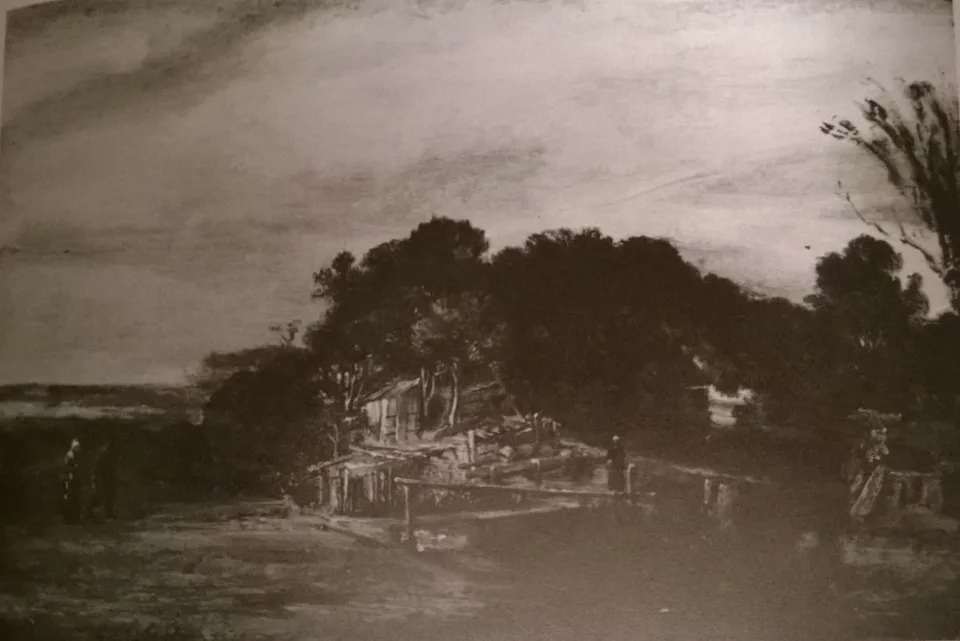
Shortly after midnight on Monday 4 September 1972, over the Labour Day weekend, three armed and masked men reached the roof of the Montreal Museum of Fine Arts. The CBC reports that one climbed a tree beside the building and lowered a ladder to the other two. A skylight on the roof was under repair, and the alarm there had been covered or left off. The men went down a rope to the second floor.
Inside, they overpowered three guards and tied them up. They took 18 paintings and 39 smaller objects, mostly jewellery and figurines. The museum’s spokesman, Bill Bantey, gave those numbers that day. One object was an 18th-century gold watch that had belonged to the wife of Jacques Viger, Montreal’s first elected mayor. The best-known painting was Landscape with Cottages, signed and dated 1654 and attributed to Rembrandt van Rijn. The CBC reports that it came to the museum as a gift from the daughter of William Van Horne, the railway builder. The museum’s list also named works attributed to Corot, Delacroix, Courbet, Millet, Rubens and Gainsborough. The thieves left behind works by El Greco, Picasso, Goya, Renoir and another Rembrandt.
The CBC and Canadian Press report that the men tried to rig a pulley to haul the loot up through the skylight, then gave up. One of them set off an alarm on a side door, and they left on foot. Later reports take that alarm as a sign that it was not an inside job. On 7 September 1972 The New York Times reported that the museum’s director, David G. Carter, and the police had received no ransom demand. It gave the Rembrandt’s value as $1 million and the 18 paintings’ value as about $2 million.
A demand did follow. The Canadian Encyclopedia and The Walrus report that within about a week the museum was guided by phone to a payphone near McGill University. A cigarette pack there held a stolen pendant. The Walrus says the thieves asked for $500,000, then for $250,000. To show good faith, they gave up a small landscape on copper attributed to Brueghel. It was left in a locker at Montreal’s Central Station. It was later judged to be the work of Brueghel’s followers, not of Jan Brueghel the Elder himself. The CBC says it and the pendant are the only two items ever recovered.
Both the Canadian Encyclopedia and The Walrus report a sting in which an undercover officer was to pay for another painting. A police car drove by, the thieves said it was a trap, and contact stopped. The Canadian Encyclopedia adds that in early summer 1973 an insurance adjuster left $10,000 at a vacant lot in Laval and received no painting. It records no ransom attempt after that summer.
The insurers paid the museum’s claim, so the paintings are legally the insurers’ property. A review of the museum’s files, reported in the Journal of Art Crime in 2011, found doubts about the attribution of about seven of the stolen paintings. The CBC adds that a Rubens that the museum bought with the insurance money was later judged to be misattributed. Alain Lacoursière, a retired Montreal police detective, told the CBC he suspects the works went to organised crime. That is his opinion, not a finding.
No one has ever been charged, arrested or publicly identified. In September 2022 the CBC and Canadian Press reported that Montreal police said the case was still open. The museum said it had no new information. The Rembrandt is still missing.
Sources
- CBC News: report on the 1972 Montreal Museum of Fine Arts theft (2017)
- CBC News and Canadian Press: report on the 1972 Montreal Museum of Fine Arts theft (September 2022)
- The Walrus: report on the 1972 Montreal Museum of Fine Arts theft (1 September 2022)
- The Canadian Encyclopedia: Skylight Caper (1972 Montreal art heist)
- Radio-Canada: report on the 1972 Montreal Museum of Fine Arts theft (2017)
- The New York Times: Lost Rembrandt baffles sleuths (7 September 1972)