 Stolen Art Dealer
Stolen · 22 October 2026
The Rembrandt stolen four times from Dulwich
A small Rembrandt portrait was taken from Dulwich Picture Gallery in 1966, 1973, 1981 and 1983. It came back every time.
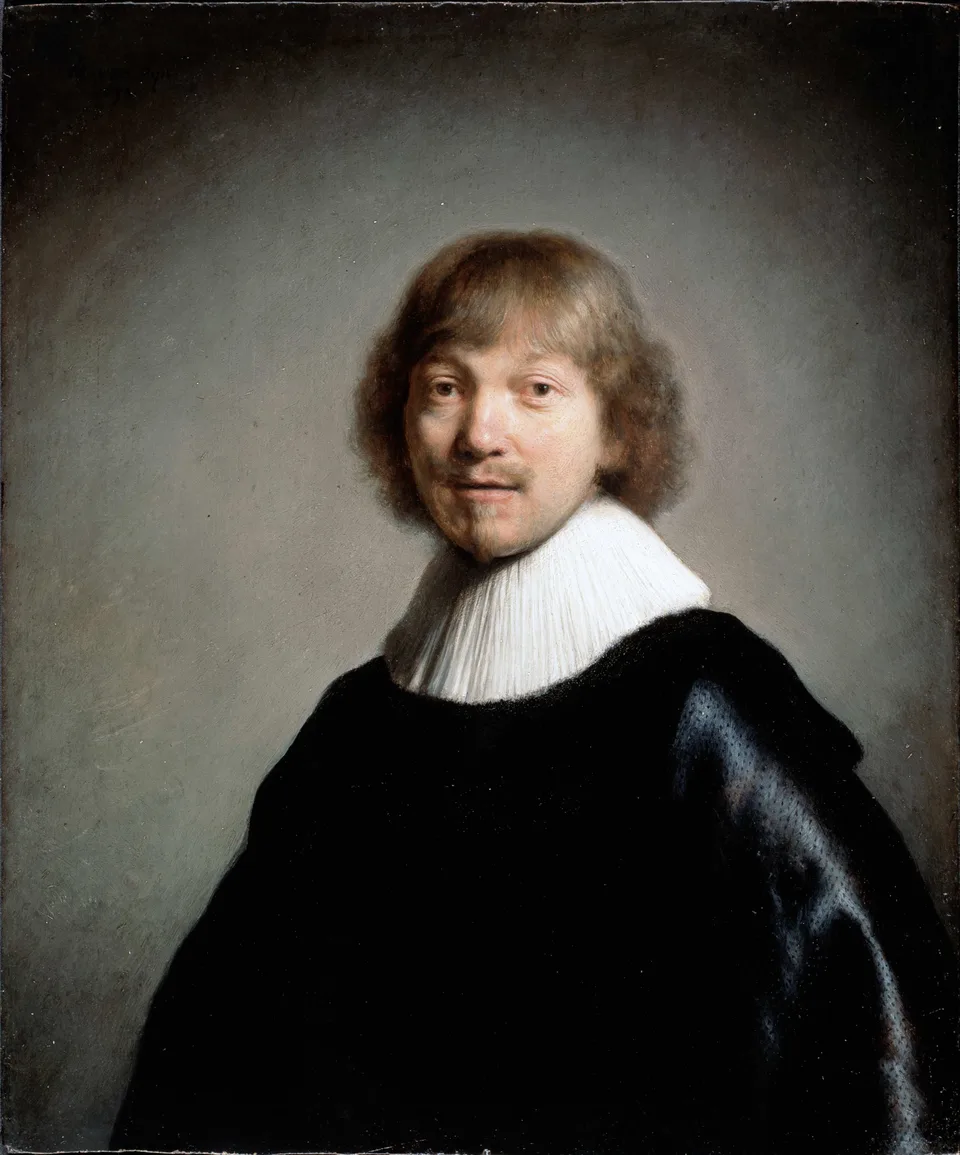
Shortly after midnight at the end of 1966, thieves drilled out a panel of a seldom-used oak door at Dulwich Picture Gallery in south London. They took eight pictures, including three Rembrandts. One was a small portrait of Jacob de Gheyn III. ArtNews gives 31 December 1966. The Dulwich Society journal says the early hours of New Year’s Day 1967, and UPI later counted 14 works. The sources do not agree on the date or the number.
The portrait is an oil on oak panel, signed and dated 1632, about 30 by 25 centimetres. The sitter is Jacob de Gheyn, a painter and engraver. The gallery has owned it since the Bourgeois bequest of 1811. The Dulwich Society journal says all eight pictures were back within days after a tip-off. Five lay in a brown paper parcel under a bush on Streatham Common and three were at a house nearby. It does not say which five, so the de Gheyn was probably in the parcel. Artnet says a dog walker found the haul. The Guardian and the BBC, in 2000, list several recoveries, one of them under a bench in a Streatham graveyard, without saying which theft each belongs to. One man was caught for 1966: an ambulance driver, aged 32. The Dulwich Society journal says he was sentenced to five years at the Old Bailey.
In 1973 a visitor put the portrait in a plastic bag and rode off on a bicycle. AFP, citing the book Stealing Rembrandts, and Artnet report that local police caught him within minutes. The sources read give no day, charge or sentence.
At nearly noon on 14 August 1981, two men entered separately. One distracted the desk attendant while the other, in a long overcoat, took the picture. The director, Giles Waterfield, was on a train to Edinburgh. On 25 August a caller from Amsterdam asked him for 100,000 pounds as a finder’s fee, according to the Dulwich Villager, a local magazine reprinted by the Dulwich Society. Waterfield told the police. On 2 September they stopped a taxi in London. UPI and The New York Times report that Detective Chief Inspector Collin Evans recovered the painting, out of its frame and undamaged. The accounts differ on the detail. UPI and the Times say four men were arrested in the taxi. The Dulwich Villager says two were in the taxi, with the picture in a briefcase, and a third was arrested at a hotel near Heathrow. UPI in 1983 says a pillow case. UPI reports that three men were jailed in 1982. The local magazine reported that a fourth man was held and acquitted.
On Saturday 28 May 1983, shortly after 1 a.m., thieves used two sets of ladders to reach the roof and enter through a skylight. Police arrived within three minutes, but the picture was gone. UPI gave a value of up to 4.5 million dollars, an estimate and not a sale price. AFP reports that no arrest was ever made. The Guardian wrote in 2000 that nobody was charged for any of the thefts. The sources above contradict that for 1966 and 1981.
On 8 October 1986 British police took the portrait back in Germany. UPI, in the Los Angeles Times, reports that prosecutors in Munster said it had been left, wrapped in paper, at the left-luggage office of the main station in September. AFP instead places it in a station on a British army base.
Guinness World Records lists it as the most stolen painting, according to the BBC. It hangs at Dulwich Picture Gallery, in Room 5.
Sources
- Dulwich Picture Gallery: collection page for Jacob III de Gheyn (read 22 October 2026)
- ArtNews: report on the thefts of Rembrandt paintings (undated)
- Artnet: report on the most stolen painting, the Takeaway Rembrandt (undated)
- UPI: report on the fourth theft of the Rembrandt (28 May 1983)
- UPI: report on the recovery of the thrice-stolen Rembrandt (2 September 1981)
- The New York Times: report on the Rembrandt recovered in London (3 September 1981)
- Los Angeles Times: report on the Rembrandt found in Munster (9 October 1986)
- Dulwich Society journal: report on Girl at a Window and the 1966 theft (Summer 2022)
- Dulwich Society journal: report on the 1981 theft, reprinting the Dulwich Villager (Autumn 2022)
- AFP via Artdaily: report on the 1973 theft and the 1983 theft (2019)
- The Guardian: report on security at Dulwich Picture Gallery (25 May 2000)
- BBC News: report on the thefts of the Rembrandt (25 May 2000)