 Stolen Art Dealer
Stolen · 22 October 2026
Van Gogh's Dr Gachet, seized from a museum
The Nazi state took the portrait from the Städel in Frankfurt in 1937. It sold in 1990 for $82.5 million including the buyer's premium, and its owner is not known.
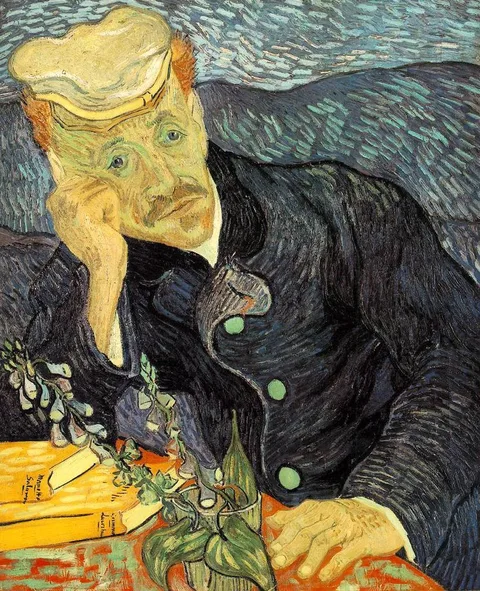
On 2 December 1937, Alfred Wolters, the director of the Städel museum in Frankfurt, was told that his Van Gogh was gone. The president of the Reich Chamber of Fine Arts, a Nazi body that controlled German art, had taken the Portrait of Dr Gachet and five other paintings from the museum’s holdings. The Städel’s own account confirms the date.
This was not a theft from a person. It was a seizure by the state, from a public museum. That year the Nazi campaign against “degenerate art” took about 20,000 works from German museums. Van Gogh was not in the Munich exhibition of such art, and the portrait stayed at the Städel through the first waves. The museum says it is not fully explained why it was taken so late. The Art Newspaper says the aim was mainly to make money. The Städel adds that Hermann Göring, Hitler’s deputy, saw high profit in Van Gogh abroad.
Van Gogh painted this portrait of his doctor, Paul Gachet, at Auvers-sur-Oise in June 1890, weeks before he died. It is the first of two versions. The second hangs in the Musée d’Orsay. The first was owned in Copenhagen by the artist Alice Ruben Faber, and it came to the Städel in 1911. Sources disagree on whether it was a gift or a purchase. In May 1938, Göring wrote that he would trade it for foreign currency and “irrevocably” take it.
The next steps are only partly documented. The Art Newspaper says Göring apparently sold it in 1938, through his dealer Josef Angerer, to Franz Koenigs, a German banker and collector in Amsterdam. Siegfried Kramarsky, a German-Jewish banker who later fled to New York, then obtained it. The Städel’s provenance researcher says the details can no longer be reconstructed. Neither the price Koenigs paid nor the exact route is known. Neither man is accused of anything in the sources. The painting hung at the Metropolitan Museum in New York, on and off, and on indefinite loan from 1984 until the 1990 sale.
On 15 May 1990 Kramarsky’s family sold it at Christie’s in New York. Bidding opened at $20 million. The hammer price was $75 million, and with the buyer’s premium the price was $82.5 million. It was then the highest price paid at auction for any artwork. Hideto Kobayashi, a Tokyo dealer, bid for a client, who days later was named as Ryoei Saito, honorary chairman of the paper company Daishowa. The Art Newspaper reports that Saito said he wanted it cremated with him. He died in 1996 and it was not.
After that the painting passed from a creditor bank, Fuji Bank, to the Austrian financier Wolfgang Flöttl, in 1997 according to the New York Times or about 1998 according to The Art Newspaper. A private sale through Sotheby’s followed in 1998. Neither the price nor the buyer was made public.
The Städel makes no claim. The Art Newspaper reports that the museum regards the removal as lawful under German law at the time, though it now seems morally wrong. In 2019 Christine Koenigs, a granddaughter of Franz Koenigs, told the paper she had made a claim on the picture, and gave no detail. The Städel showed an empty frame in its 2019 Van Gogh exhibition. The painting is in a private collection and has not been shown since 1990. Its present owner is not known. A press report in December 2024 named a possible holder, but The Art Newspaper called it unconfirmed.
Sources
- The Art Newspaper: report on the whereabouts of Van Gogh's Portrait of Dr Gachet (15 November 2019)
- Städel Museum: Städel Stories account of the seizure of Van Gogh's Portrait of Dr Gachet
- The New York Times: report on the Christie's sale of Van Gogh's Portrait of Dr Gachet (16 May 1990)
- Judd Tully, Washington Post: $82.5 million for Van Gogh (16 May 1990)
- The New York Times: report on the buyer of the Van Gogh and a Renoir (19 May 1990)
- The Art Newspaper: report on the long-hidden Van Gogh portrait (20 December 2024)