 Stolen Art Dealer
Stolen · 22 October 2026
A Kandinsky returned to the Stern family in 2022
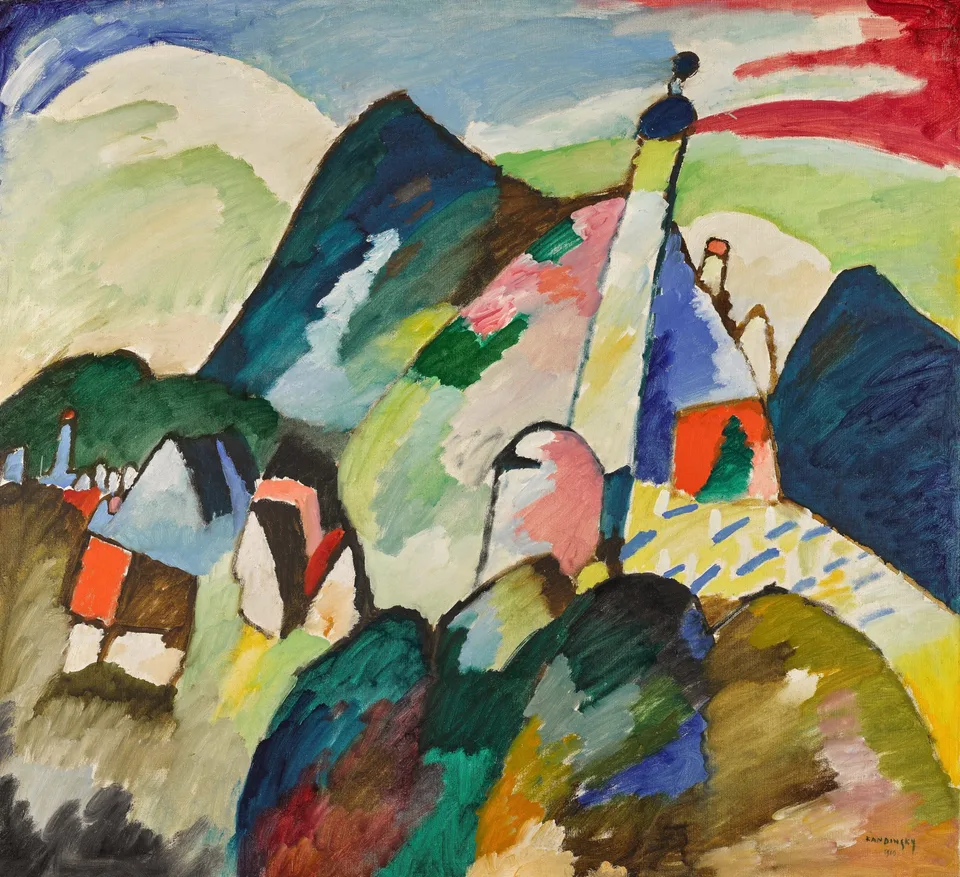
A Dutch museum kept Kandinsky's Murnau mit Kirche II for 70 years. A second ruling in 2022 returned it to the heirs of Johanna Margarethe Stern-Lippmann.
On 27 April 1944, Johanna Margarethe Stern-Lippmann was arrested in Bussum, in the Netherlands. She had been hiding there from the German occupiers. Someone had betrayed her. About ten days later she was held at the Westerbork camp, and she was then deported to Auschwitz, where she was murdered. Sotheby’s gives the month of her death as May 1944.
She was a Jewish woman from Berlin, born in 1874. With her husband, Samuel Siegbert Stern, who co-owned a textile firm, she had lived in Babelsberg, near Berlin. They had four children. A will of 1924 lists 144 objects, including more than 100 paintings and drawings. One was a Kandinsky landscape. It was an oil on canvas of 1910, 96 by 105.5 centimetres, showing a view of Murnau. A family album photograph of the house shows it on a wall. The date of the purchase is not known.
Siegbert died in Berlin in August 1935, of natural causes. His widow kept the collection. After 1933 the family was persecuted, and in 1937 she left Babelsberg. In 1938 she fled by way of Switzerland to the Netherlands. She sold works of art around 1938 and again during the occupation, and the Dutch Restitutions Committee records that a dealer, Myrtil Frank, acted as an intermediary in some of those sales. In 1941 the Nazi regime declared her stateless. She never received the emigration visa she sought.
How the Kandinsky left her hands is not documented. The Committee, an independent Dutch body that advises on claims for looted art, found it “sufficiently plausible” that she lost it during the occupation and that it passed to Frank and his wife Flory. Sotheby’s says Frank “probably acquired” it between December 1941 and April 1943. The Art Newspaper reports that a postcard of 1966 from Flory Frank, showing the painting, says “This was our Kandinsky”. Karl Legat, a dealer in The Hague, sold it to the city council of Eindhoven in December 1951. The Van Abbemuseum, the city’s museum, showed it for decades. Its inventory card gave another history, a Kaufmann collection. The Committee judged that account improbable.
The family claimed the painting formally in 2015. On 29 January 2018 the Committee advised that there were not enough facts to show the work had left her hands under Nazi rule, and the city was not obliged to return it. The Committee did not doubt that the family had owned it. In 2019 the city and the heirs asked the Committee together to look again. This was a new request, and a second opinion followed. Dated 12 September 2022, it recommended return. The Committee noted that the Kaufmann story was improbable, that the family had believed until 1952 that it still owned the painting, and that the postcard linked the Franks to it. Eindhoven agreed.
The heirs consigned the painting to Sotheby’s. It sold in London on 1 March 2023, as lot 115, for 37,196,800 pounds, including the buyer’s premium. The Guardian reported it as an auction record for Kandinsky. Sotheby’s says the proceeds are shared among 13 Stern descendants, and that part will fund research into the rest of the collection. The reports used for this entry do not name the buyer.
Sources
- Restitutions Committee: Stern-Lippmann and Eindhoven City Council II, binding opinion (12 September 2022)
- Restitutions Committee: news item on the return of the Kandinsky (15 September 2022)
- Van Abbemuseum: response to the second binding opinion (15 September 2022)
- DutchNews: report on the Nazi-looted Kandinsky to be returned to the heirs (September 2022)
- The Art Newspaper: report on the postcard that helped the heirs retrieve the Kandinsky (8 November 2022)
- Sotheby's: lot page for Kandinsky, Murnau mit Kirche II (lot 115, 1 March 2023)
- Sotheby's: press release on the Kandinsky sale in London (2023)
- The Guardian: report on the Kandinsky sale in London (3 March 2023)