 Stolen Art Dealer
Stolen · 22 October 2026
Kandinsky's Painting with Houses and the Lewenstein claim
Sold in Amsterdam in October 1940 for 160 guilders, the Kandinsky stayed in a city museum until 2022, when the city returned it to the Lewenstein heirs.
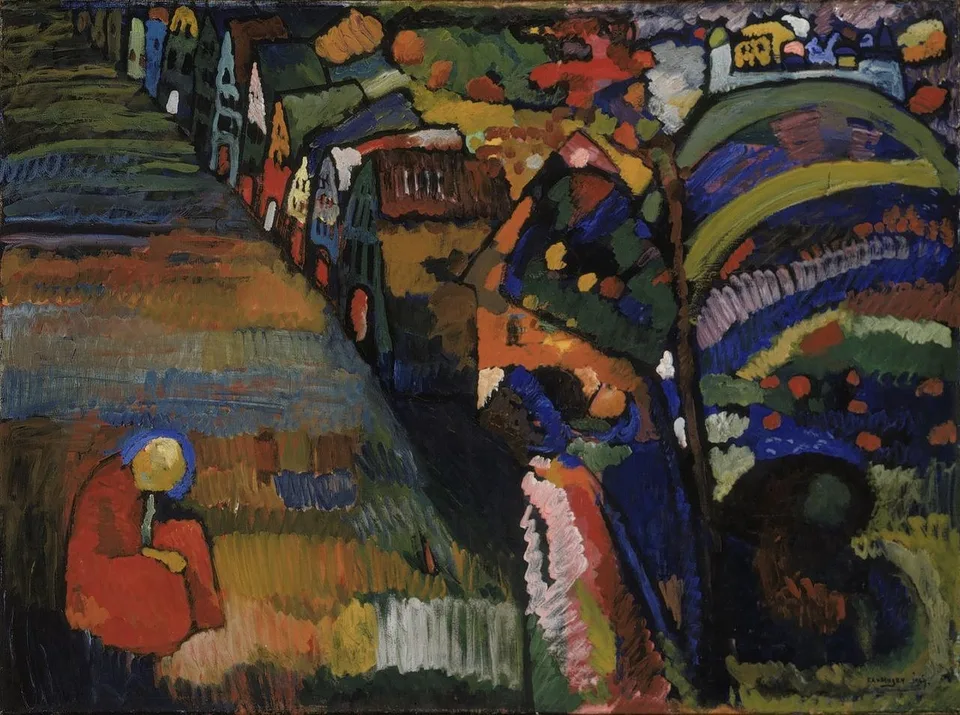
On 9 October 1940, five months after German forces invaded the Netherlands, the Amsterdam auction house Frederik Muller offered a painting by Wassily Kandinsky as lot 205. The catalogue called it “Compositie” and gave its size as 97 by 132 centimetres. It stood in a part of the sale headed with the letter L and the word Amsterdam, and one copy carries a hand-written note with the name “Leuwenstein”. The Stedelijk Museum bought it for the city. The hammer price was 160 guilders. With the 10 per cent buyer’s premium the cost was 176 guilders.
The work is an oil on canvas, signed and dated 1909, known as Bild mit Häusern or Painting with Houses. The Restitutions Committee, the Dutch body that advises the government on claims for art lost in the Nazi period, says Emanuel Albert Lewenstein probably bought it in 1923 for 500 guilders. He directed his family’s sewing-machine firm in Amsterdam and collected modern art. He died in 1930. His widow, Hedwig, owned the painting until her death on 25 May 1937. A deed of 24 January 1938 gave her movable property to their son Robert. The Committee read it as covering the painting, though it named no artworks.
Robert left Amsterdam in 1938. His wife, Irma Klein, a German-born Jewish actress, stayed. He went to the south of France in 1939 and to the United States in June 1940. Before the war the couple’s lawyers had already discussed selling the collection. A court granted a legal separation on 27 June 1940. The Committee found that the painting belonged to the couple’s joint property at the time of the sale. It could not say who sent it to the auction or where the money went.
In November 2012 the Lewenstein heirs, through Mondex Corporation, a Canadian firm that works on looted-art claims, asked the museum to return the painting. In 2013 the Minister of Culture asked the Committee for a binding opinion, and both sides agreed to accept it. On 22 October 2018 the Committee found no confiscation. It found the sale could not be seen apart from the Nazi regime, but that money problems had begun before the invasion, and that the city bought in good faith. Weighing the interests, it advised that Amsterdam need not return the work. The Amsterdam District Court rejected the heirs’ challenge on 16 December 2020.
Policy then changed. On 7 December 2020 the Kohnstamm Committee, a government evaluation panel, reported that the weighing of interests had sometimes detracted from the pursuit of justice. A new decree took effect on 22 April 2021. On 26 August 2021 Mayor Femke Halsema and Deputy Mayor Touria Meliani announced that the city would return the painting without a new review. The handover took place at the Stedelijk on 27 or 28 February 2022. The museum’s release is dated 27 February. NRC gives 28 February.
NRC reported on 22 February 2023, citing people involved, that the heirs had sold the painting to a private collector for more than 60 million euros through a large auction house. This was a private sale and not a public auction. No house, lot or price basis has been published, and the museum and the city declined to comment, according to NOS. The painting is now thought to be in private hands and is not on public view. The latest source for this is dated February 2023. No source alleges an offence by any person named here.
Sources
- Restitutions Committee: report on the binding opinion on Painting with Houses (22 Oct 2018)
- Restitutions Committee: report on the opinion on Painting with Houses (1 Nov 2018)
- Amsterdam District Court: judgment on the claim over Painting with Houses (16 Dec 2020)
- The Art Newspaper: report on the Kohnstamm Committee findings (7 Dec 2020)
- Restitutions Committee: report on the new decree (22 Apr 2021)
- NOS: report on Amsterdam's decision to return the Kandinsky (26 Aug 2021)
- Stedelijk Museum: release on the handover of the Kandinsky (27 Feb 2022)
- NRC: report on the Kandinsky leaving the Stedelijk (28 Feb 2022)
- NRC: report on the sale of the Kandinsky (22 Feb 2023)